
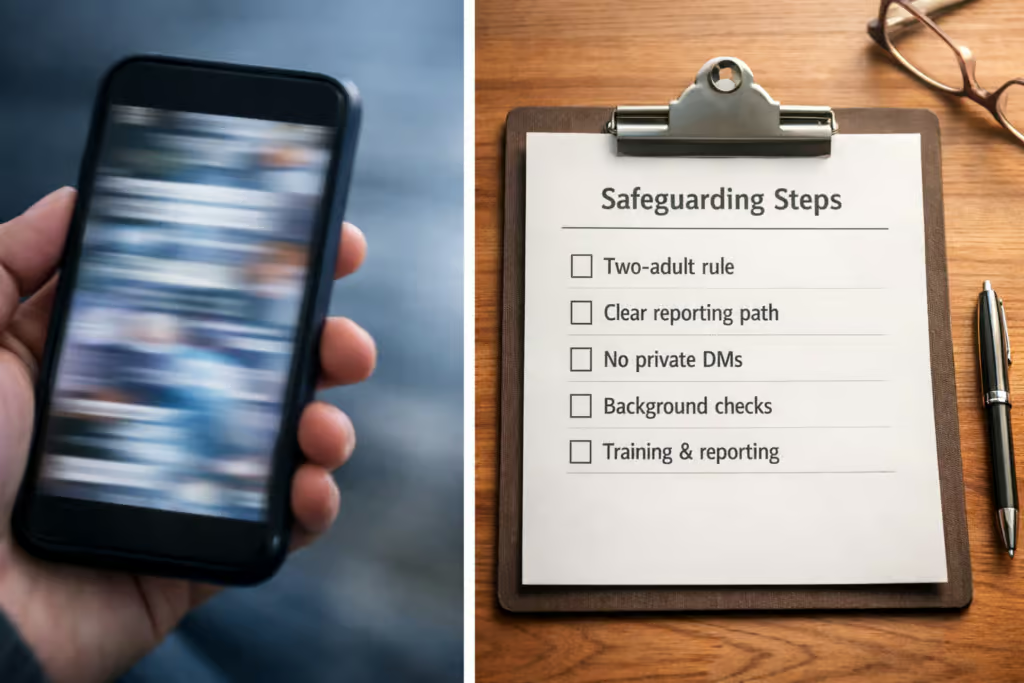
There are seasons when the headlines don’t merely inform you—they press on your chest.
A new documentary. A high-profile case. Fresh details and reactions and “updates,” arriving faster than any human heart can faithfully carry. You feel what you should feel: grief, anger, a longing for justice, and a protective instinct for the vulnerable.
And then, if we’re not careful, something else happens.
The flood becomes a fog.
Because when your mind is overloaded, your body shifts into survival mode. And when leaders live in survival mode, we become reactive—quick to speak, slow to listen, exhausted before we ever build what truly protects.
Outrage is not the same as action. Sometimes it’s the thing that prevents it.
The Outrage Cycle: Moral Energy Without Moral Direction
Many of us have learned the pattern by now:
You’re shown enough darkness to awaken a real moral response.
You’re given far too much to process responsibly.
You’re offered a few villains—someone to aim at—so the pressure can discharge.
The cycle repeats, louder each time, until your moral clarity becomes emotional captivity.
That captivity doesn’t mean you’re “soft” on evil. It means you’re flooded.
And flooded leaders are easier to steer.
Harm doesn’t only spread through secrecy. It also spreads through noise—because noise fractures discernment, and discernment is where wise protection is born.
Justice vs. Emotional Capture
We need language sturdy enough for this moment.
Justice seeks truth, protection for the vulnerable, due process, consequences, repair, and better systems.
Emotional capture seeks relief—someone to blame, a spectacle, a momentary sense of control.
Justice can be patient without being passive.
Justice can be fierce without becoming fevered.
Justice can name evil without letting evil set the temperature of our souls.
If you lead people, your inner steadiness is not a luxury. It is part of your calling.
A Simple Rule for Leaders
Here’s a rule worth keeping near:
If it spikes adrenaline but doesn’t produce a next step, it’s probably a distraction.
If it clarifies risk and produces protective action, it’s worth your attention.
You don’t need less moral concern.
You need more moral direction.
The Only Place You Can Actually Build: Your Sphere
It’s easy to feel powerful by sharing the right post. It’s easy to comment, to rage, to repost, to keep up with every new detail.
But the places where predation becomes difficult are rarely built online.
Predators thrive wherever people are:
isolated,
ashamed,
treated as less than fully human,
protected by silence, or
managed for “image” instead of cared for with truth.
So the question is not only, “Who should be held accountable out there?”
It is also: “Where are the vulnerable in my world—and what standards will protect them here?”
Start where responsibility is real.
Start where you can actually build.
Safeguards You Can Implement Now
1) Start With Your Home (If Children Are in Your Life)
Home is often the first line of protection—not through fear, but through clarity.
Practical standards to consider:
No forced affection: children never have to hug, kiss, or touch adults to be “polite.”
No private adult-child messaging: if an adult needs to text, a parent/guardian is included.
Sleepover and travel clarity: clear supervision rules, sleeping arrangements, and adult access.
Device accountability: transparent expectations and open access—not secretive surveillance.
Secrets vs. surprises: surprises end; secrets isolate. Teach that adults asking for secrets is a danger signal.
A family “help list”: 3–5 trusted adults a child can tell if something feels wrong—without punishment.
A simple phrase that helps:
“We don’t keep secrets with adults. We do surprises that end on a date.”
Your goal is not paranoia. Your goal is a home where a child can speak without fearing consequences.
2) Then Your Church (Where Trust Is Often Assumed)
Many churches love children deeply—and still become vulnerable because trust is assumed, policies are vague, or enforcement collapses when someone is “beloved.”
Ask clearly:
Do we screen and vet anyone who works with minors?
Do we have a two-adult standard (avoiding isolated one-on-one access)?
Are rooms observable (windows/open doors where appropriate)?
Have we trained leaders on reporting responsibilities and how to respond to disclosures?
Is there a reporting pathway that does not depend on proximity to the accused or the ministry “chain of command”?
Are policies enforced consistently—even when it’s awkward?
Write this down somewhere visible:
Protection is not a vibe. It’s a system.
And systems only protect when they’re practiced.
3) Extend to Schools, Sports, and Youth Programs
Wherever minors gather, clarity matters.
Look for:
clear rules for travel, overnights, and hotel stays,
limits on private contact between adults and kids (group communication whenever possible),
guardrails around one-on-one instruction,
a culture where concerns are welcomed—not punished,
a reporting route that’s independent enough to be trusted.
If a program cannot describe its safeguards plainly, it may not have them.
4) Remember: Vulnerability Isn’t Only About Children
Protection is a way of life, not a single policy.
Consider where your church or community can strengthen safeguards for:
isolated seniors,
people with disabilities,
foster/adopt systems under strain,
recovery communities vulnerable to manipulation,
immigrants and undocumented neighbors who fear authorities,
the poor and unhoused who are exposed to coercion,
online spaces where grooming and blackmail can thrive.
Justice becomes real when protection becomes normal.
The Way Forward: Calm, Clear, Relentless
You do not have to choose between being informed and being consumed.
Choose something steadier:
Stay clear.
Stay grounded.
Act where you can actually build.
Strengthen the systems closest to you.
Raise standards until predation becomes difficult.
Outrage burns hot and burns out.
Standards protect the vulnerable for decades.
If you want to fight darkness, don’t donate your attention to the outrage economy.
Use your attention to build what predators cannot use.
A closing practice for the next seven days:
When a story spikes your anger, pause and ask:
“What safeguard can I strengthen this week—in my home, my ministry, or my community?”
Then do the next small, concrete step.
That’s how protection is built. Quietly. Faithfully. Over time.
#ChurchTrainingCenter #DiscerningLeadership #KeithClarkHoyos #ChurchLeadership #ChildSafety #Safeguarding #TraumaInformed #ProtectTheVulnerable #MinistryLeadership #HealthyChurch #YouthMinistry #PastoralLeadership