
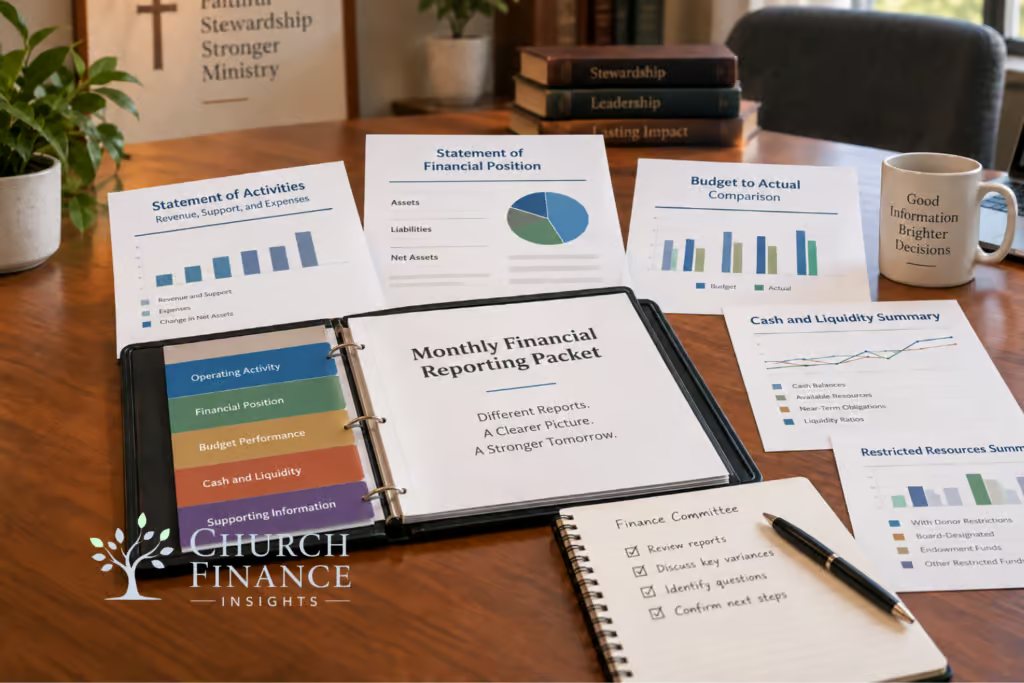
Most finance committees inherit their monthly financial packet rather than design it. A treasurer or bookkeeper prints the reports that have always been printed, adds a bank balance or budget comparison, and sends the packet to the committee.
The reports may all be useful. The harder question is whether, taken together, they answer the financial questions the committee is responsible for asking.
There is no single monthly reporting package required for every church. FASB Topic 958 governs not-for-profit financial reporting under U.S. GAAP, while COSO provides principles for internal control and information; neither prescribes a specific monthly packet for a church finance committee. AICPA & CIMA guidance in Demystifying the not-for-profit liquidity disclosures and What’s the plan? Best industry practices in not-for-profit budgeting and financial planning likewise addresses financial reporting, liquidity, budgeting, and forecasting without establishing one standardized monthly committee package.
The right package depends on the church’s accounting basis, financial complexity, restrictions, obligations, and oversight responsibilities. For most churches, however, the recurring information should help leaders answer five different questions:
What happened financially during the period?
What is the church’s financial position at the end of the period?
How did actual results compare with the approved budget?
What cash and other resources are actually available for near-term needs?
What material restrictions, obligations, or unusual matters need separate explanation?
Those questions provide a better starting point than whatever reports the accounting software happens to print.
Show What Happened During the Period
The first part of the package should show the church’s financial activity for the month and, ordinarily, year to date.
For churches preparing financial statements under U.S. GAAP, the statement of activities is one of the primary not-for-profit financial statements. It reports revenue, support, expenses, and changes in net assets over a period. Churches using another accounting basis may use an income-and-expense report, profit-and-loss report, or another comparable statement. The terminology may differ, but the committee still needs a reliable view of what was received and what was spent during the period.
The FASB Accounting Standards Codification is the authoritative source of nongovernmental U.S. GAAP; Topic 958 covers not-for-profit entities. ASU 2016-14 communicated amendments to the Codification but is not authoritative GAAP.
This report answers an operating question. It does not tell the committee everything about cash, liabilities, restrictions, or future obligations. It should therefore be read as one part of the monthly package rather than as the whole financial picture.
Show the Church’s Financial Position
A finance committee also needs a point-in-time view of what the church has and what it owes.
For a church preparing GAAP-basis not-for-profit statements, that is the statement of financial position. It presents assets, liabilities, and net assets at a particular date. Current not-for-profit GAAP distinguishes net assets with donor restrictions from net assets without donor restrictions.
Many accounting systems call this a balance sheet. Whatever the label, the purpose is different from the operating statement. A church can report a surplus for the month while carrying significant liabilities. It can also hold substantial assets while having relatively little cash available for ordinary operations.
The committee does not need to become expert in every balance-sheet account, but it should receive enough financial-position information to see material assets, obligations, and net-asset balances rather than relying only on the month’s income and expenses.
Compare Actual Results With the Budget
A budget-to-actual report answers another question: How does what actually happened compare with what the church planned?
Budget-to-actual reporting is not a GAAP requirement for an internal church finance committee. It is an internal financial-management tool. AICPA & CIMA’s What’s the plan? Best industry practices in not-for-profit budgeting and financial planning distinguishes actual results from budgets and forecasts because each serves a different planning purpose.
For recurring oversight, a useful comparison will usually allow the committee to see current and year-to-date results against an appropriately comparable budget. The committee can then identify differences that deserve explanation or follow-up.
That does not mean every variance needs discussion. Nor does a favorable number automatically mean good news or an unfavorable number automatically mean something has gone wrong. Detailed report design and variance interpretation require their own analysis. The monthly package simply needs to make meaningful departures from the financial plan visible enough to be examined.
Include Cash and Liquidity Context
Cash matters, but a bank balance alone does not tell the committee how much the church can responsibly use.
Some cash may be subject to donor restrictions. Some resources may have been designated by the governing body. Near-term payroll, debt service, accounts payable, or other commitments may place demands on cash that are not obvious from the bank balance.
For not-for-profits preparing GAAP financial statements, Topic 958 requires information about liquidity and the availability of financial assets for general expenditures. FASB’s ASU 2016-14 communicated the amendments establishing this presentation and disclosure framework. AICPA & CIMA’s Demystifying the not-for-profit liquidity disclosures provides professional guidance on applying those concepts.
Those formal annual disclosures do not have to be recreated as a monthly internal report. The underlying distinction is still useful: resources that appear liquid are not necessarily available for every purpose.
The format should fit the church. A congregation with stable giving, few restrictions, little debt, and predictable expenses may need only a concise cash-and-obligations view. A church with seasonal giving, major payroll commitments, restricted campaigns, grants, debt, construction, or volatile cash flow may need a rolling cash forecast or a more developed liquidity schedule.
A formal statement of cash flows may be useful in some settings. Topic 958 includes a statement of cash flows as part of a complete GAAP not-for-profit financial-statement set, but that does not make the formal statement a required monthly internal report for every church finance committee.
Add Supporting Schedules When They Explain Something Material
The primary statements and budget comparison will not always provide enough detail.
A church with significant donor-restricted resources may need a restricted-resource summary. Debt may call for a debt-service schedule. Investments or endowments may require additional information about balances and availability. A reimbursement-based grant may make receivables and cash timing especially important. A capital project may require a sources-and-uses report or commitments schedule.
The principle is not to add every available report. It is to add supporting information when the primary reports would otherwise leave a material financial condition unexplained.
The same applies to exceptions. A large unusual expense, unresolved accounting matter, significant change in giving, or material obligation may need a short written explanation rather than another multi-page report.
COSO’s Internal Control—Integrated Framework emphasizes the use and communication of relevant, quality information. It does not prescribe the names, number, or monthly frequency of reports for a church finance committee. The practical implication is that the packet should be designed around what the committee genuinely needs to understand and review.
Make the Package Fit the Church
Church size can affect reporting needs, but complexity is often the more important factor.
A small church with one operating account, predictable expenses, and few restricted resources may be well served by a concise operating report, balance-sheet-style report, budget comparison, and cash summary. That is not inadequate reporting simply because the packet is short.
A larger or more complex church may need departmental reports, restricted-resource schedules, investment information, debt reporting, grant schedules, or cash forecasts. A mid-size church can also require that level of detail when it operates multiple ministries, carries debt, administers significant restricted funds, or experiences seasonal cash flow.
The accounting basis matters as well. A cash-basis church should not present its internal reports as though they contain the same information as accrual-basis GAAP statements. Unpaid bills, receivables, accrued payroll, depreciation, and other items may be treated differently or may not appear at all. The committee needs to understand the basis used so it does not ask a report to answer a question the report cannot answer.
The monthly reporting package also should not compensate for an unfinished close. If significant accounts remain unreconciled or material accounting issues are unresolved, producing more reports does not make the underlying records ready.
The inherited packet at the beginning of this article may already contain everything the committee needs. If it does not, the solution is not automatically to print more pages. The finance committee should identify which financial question remains unanswered and then determine what reliable report, schedule, or explanation will answer it.
A useful recurring package gives leaders a view of operating activity, financial position, budget performance, cash or liquidity, and any material condition that requires separate attention. The exact form should remain proportionate to the church that is using it.
Sources
Financial Accounting Standards Board. Accounting Standards Codification Topic 958, Not-for-Profit Entities. The FASB Accounting Standards Codification is the authoritative source of nongovernmental U.S. GAAP. Accessed 2026-09-08.
Financial Accounting Standards Board. Accounting Standards Update No. 2016-14: Not-for-Profit Entities (Topic 958)—Presentation of Financial Statements of Not-for-Profit Entities, August 2016. The ASU communicates amendments to the Codification; it is not itself the authoritative source of GAAP. Accessed 2026-09-08.
AICPA & CIMA. Demystifying the not-for-profit liquidity disclosures, March 17, 2025. Accessed 2026-09-08.
AICPA & CIMA. What’s the plan? Best industry practices in not-for-profit budgeting and financial planning, July 16, 2026. Accessed 2026-09-08.
Committee of Sponsoring Organizations of the Treadway Commission. Internal Control—Integrated Framework, refreshed 2013. Accessed 2026-09-08.