
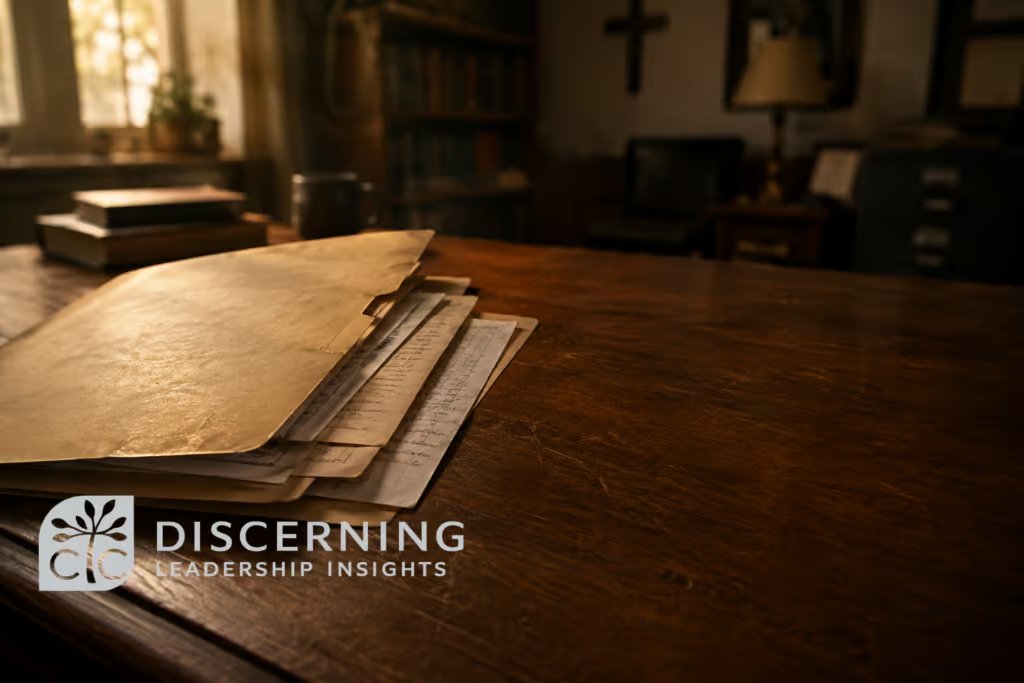
A new moderator opens the folder left by the previous moderator. It may be a binder pulled from a cabinet in the church office, with meeting minutes clipped in order and a few sticky notes curling at the edges. It may be a shared drive with file names that made sense to someone two years ago. It may be an email thread forwarded with the note, “This should have what you need.”
There is usually plenty inside: agendas, budgets, bylaws, committee lists, financial reports, policies, a calendar, and a few unfinished tasks. The folder can tell the new leader what happened, but it rarely tells them what the church was listening for.
It does not explain why a vote felt heavy. It does not say what grief had to be named before the decision could be made. It does not reveal why an ordinary policy carried the memory of a painful breach of trust, or what leaders believed faithfulness required when the congregation had more expectation than energy.
The work is handed on, but the listening often is not.
This is one of the less visible losses in church life. A group of leaders may spend months discerning a difficult path. They pray, study reports, listen to tired volunteers, face uncomfortable financial realities, sit with congregational anxiety, and slowly recognize that something has to change. The decision may feel sober, costly, and faithful. A year later, all of that spiritual labor may appear in the minutes as one clean sentence: “Motion carried.”
The record is accurate. It is also thin.
Churches know how to remember decisions. We know how to record what was approved, who was assigned, what amount was budgeted, which policy was updated, and when the next report is due. This kind of clarity matters. Faithful governance does not float above administrative order. A church that cannot remember what it decided will eventually exhaust its leaders and confuse its members.
Accurate records, however, do not guarantee faithful memory. A church can preserve the motion and lose the surrender. It can keep the policy and forget the wound the policy was meant to protect. It can carry forward a ministry calendar long after the Calling that once gave it life has become difficult to name.
When that happens, the church may still know what it does. It may no longer know why. Or it may know only through phrases that have become too familiar to examine: “We have always done it this way.” “That was decided before my time.” “We tried that once.” “People were upset.” “It’s complicated.”
Those phrases may contain truth. They may carry fragments of real experience. They may also be signs that institutional memory has taken the place of spiritual memory.
Institutional memory remembers habits, precedents, anxieties, loyalties, and wounds. It remembers who used to hold influence, which pastor made a decision, which meeting went badly, and which subject still makes people glance across the table before speaking. This kind of memory can keep a church from pretending history does not matter. It can also keep a congregation trapped inside an old emotional map.
Spiritual memory has a different texture. It remembers what the community was trying to hear. It remembers where the church sensed an invitation, a correction, a limit, or a call. It remembers the moment leaders realized that Energy, Resources, and Calling were no longer aligned. It remembers the courage beneath a financial change, the tenderness beneath a staffing decision, the humility beneath an apology, the hope beneath a ministry experiment.
That kind of memory does not turn the past into a shrine. It keeps the church accountable to the listening that shaped its life.
This follows naturally from the theology hidden in governance. If governance teaches the church what matters, then the church’s structures also teach what deserves to be remembered. Minutes, agendas, budgets, covenants, reports, and leadership handoffs are never merely containers for information. They shape what future leaders will be able to see.
The problem shows up in ordinary ways.
A church adopts a building-use policy after a season of uncomfortable conflict. The fellowship hall had become harder to manage. One group expected access without notice. Another left the kitchen in disarray. A longtime member assumed she could make exceptions because she had always handled the calendar. Volunteers began to feel taken for granted. Hospitality, which was supposed to be a shared ministry, had become dependent on whoever had the most influence or the most patience.
After several hard conversations, the leaders adopt a policy. It sets expectations, clarifies authority, names cleanup responsibilities, and protects the people who had been absorbing the strain.
Two years later, a new leader reads the policy and sees only rules.
Why are we making this so complicated?
Why does everything need a form?
Why can’t we just trust people?
Those are fair questions. They may even be the right questions for a new season. Without the memory of why the policy was created, though, the conversation begins too late. The leader has inherited procedure without context. The church is left debating bureaucracy when the deeper issue was trust.
This is how structures forget why.
Minutes do not need to transcribe every discussion or preserve every emotion in the room. When a decision carries spiritual weight, though, the record can hold more than the vote. It can name, with care, the discerned purpose behind the action.
That may be as simple as one sentence: “After reviewing volunteer capacity and listening to ministry leaders, the board affirmed that the summer program should pause for one year so the congregation can attend honestly to rest, staffing limits, and where energy is now present.”
A sentence like that does not explain everything. It gives future leaders a doorway back into the discernment.
A budget does not need to become a theological essay. It can still tell a short truth about how resources are being aligned with Calling, where energy is strong, where capacity is limited, and what tradeoffs leaders have recognized. Without that narrative, future leaders may see only increases and cuts. They may miss the faithful reasoning beneath the numbers.
An agenda can do similar work. Near the beginning of a board meeting, before the first report, a chair might pause over a ministry proposal and ask, “What have we already learned about our capacity here?” The room may not become mystical. No one may say anything profound. But the question can change the posture of the conversation. It reminds leaders that unfinished tasks are not the root of the church’s life.
These are small practices. They do not require a new program or a more complicated church. They require leaders to believe that discernment deserves to be remembered.
Without that memory, each new season begins with fragments. A treasurer receives reports but not the story beneath the numbers. A board chair receives agendas but not the weight of unresolved questions. A pastor hears that a ministry was controversial, but not what the controversy revealed about the congregation’s fear, hope, fatigue, or longing. A committee is asked to continue work that no one can clearly connect to Calling.
Old questions return without context. Decisions get reopened because the deeper reason for them has disappeared. Anxiety takes on new vocabulary. A habit shaped by one season is treated as wisdom for every season. A temporary structure becomes permanent because no one remembers the circumstance that created it.
Sometimes this repetition feels like stability. The calendar continues. The committees meet. The reports are received. The same decisions move through the same channels. There is comfort in that, especially for communities that have endured disruption. But stability without remembered discernment becomes thin. It may keep the institution moving while its deeper attentiveness weakens.
Some decisions mark the life of a congregation: ending a ministry, reducing staff hours, selling property, changing worship patterns, confronting misconduct, restructuring leadership, or admitting that the congregation’s resources can no longer sustain its inherited expectations. If the church records only the outcome, future leaders may inherit the pain without the discernment.
They may know people were upset. They may sense that a subject carries emotional charge. They may learn which names are connected to which conflict. What they may not receive is the truth the church was trying to face.
A structure that remembers the Spirit helps a congregation tell the truth with care. It does not flatten difficulty into a clean institutional summary, and it does not keep wounds open for the sake of accuracy. It preserves enough faithful memory that the church can learn from what it has lived.
There is a difference between remembering and rehearsing. Some churches rehearse the past in ways that do not lead to wisdom. The same story appears whenever change is proposed. The same disappointment is used to explain why trust is impossible. The same failed attempt becomes evidence that risk should be avoided. The congregation keeps returning to pain, but not always to discernment.
Spiritual memory can remember grief without making grief the only teacher. It can remember mistakes without turning them into identity. It can remember conflict without requiring every future leader to inherit the same defensiveness. It can remember a faithful decision without demanding that the decision be repeated in a different season.
A church that remembers the Spirit does not say, “We already decided, so the matter is closed.” It says, “Here is what we heard then. Here is what we were trying to protect. Here is what we feared. Here is what we released. Here is where we were faithful as best we knew, and here is where we may still need mercy. Now we listen again.”
That kind of memory gives a church continuity without control. Congregations suffer when every new board has to rediscover the same truths, every new pastor has to reconstruct the same history, every new budget season becomes a fresh argument about identity, and every leadership transition scatters what had been learned.
Control uses the past differently. It turns precedent into a wall. It treats previous discernment as possession rather than gift. It protects the institution from being addressed again by the Spirit. Structures that remember the Spirit resist both amnesia and control. They help a church remain accountable to what it has heard without pretending that yesterday’s clarity removes the need for today’s attentiveness.
This matters especially for Calling. A congregation may speak often about mission, values, heritage, or identity while its actual structures carry a different story. The budget may protect what the church no longer has energy to sustain. The agenda may privilege maintenance while leaving little room for listening. The committee structure may continue a form of ministry that once made sense but now survives mostly by expectation. The calendar may say more about inherited obligation than present discernment.
When structures forget Calling, leaders are left managing activity. When structures remember Calling, they help the church ask whether the activity still has life.
No structure can guarantee faithfulness. Thoughtful minutes can go unread. A wise policy can be misused. A covenant can be contradicted by the emotional habits of the room. Structures do not contain the Spirit, but they can help a community remember how it tried to listen.
Many church leaders receive responsibility without context. They inherit tasks, tensions, expectations, and unfinished stories. They are asked to lead faithfully inside systems whose spiritual memory may be scattered among longtime members, retiring officers, old minutes, pastoral recollections, and things people know but rarely say directly.
Part of discernment-rooted governance is making the church’s listening more shareable: not simpler, not cleaner than it really was, but available enough that future leaders are not left guessing what faithfulness once required.
That kind of memory does not make leadership easy. It makes leadership less disoriented. It tells the moderator that the agenda came from somewhere. It tells the treasurer that the numbers have a story. It tells the pastor that a policy may be carrying grief as well as procedure. It tells the committee chair that the work before them began before them and will continue after them.
It also tells the church something about itself. We are not only a community that approves, assigns, spends, manages, and reports. We are a community trying to listen.
If that is true, our structures should remember more than what we did. They should help us remember how we listened, what we heard, what we could not yet hear, and why we must keep returning to the root.
And when the next leader opens the folder, perhaps they will find more than evidence of work completed. Perhaps they will find traces of a congregation trying, with all its limits and hope, to remain available to the Spirit.