
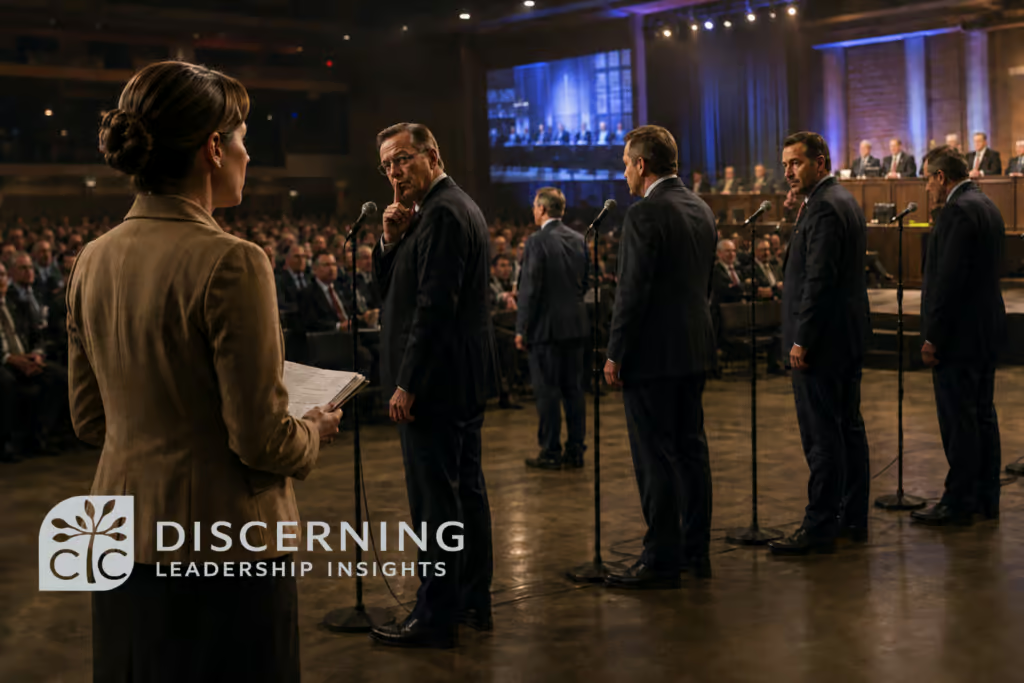
A vote can look clean from a distance.
The motion is introduced. The language is read. Messengers rise to microphones. Someone speaks for it. Someone speaks against it. The chair recognizes the next person in line. There are rules for the order of business, rules for debate, rules for amendment, rules for what happens next. The screens tell people when to vote. The ballots are counted. The result is announced.
From the outside, it looks like governance doing what governance does.
But inside the life of the church, a vote can carry more than procedure. It can tell a young woman listening from home whether the call she has been carrying in prayer will ever be received as holy. It can tell a congregation that has discerned the gifts of a faithful pastor that its discernment will be treated as disorder. It can tell a denomination what kinds of voices it has decided in advance not to hear.
This week, the Southern Baptist Convention moved closer to embedding that kind of decision into its constitution. At its 2026 annual meeting in Orlando, messengers voted 6,028 to 2,026 to advance a constitutional amendment that would bar churches with women pastors from being considered in “friendly cooperation” with the denomination. The amendment is not yet final. It must receive another two-thirds vote at the 2027 annual meeting before becoming part of the Southern Baptist Convention constitution. But even as a first vote, it reveals something spiritually significant about the relationship between governance, structure, and discernment.
This is not only a Southern Baptist story.
It is a story about what happens when governance structures decide in advance whose Calling can be recognized.
I write from the conviction that the Spirit calls and gifts both women and men for pastoral ministry. I also write with respect for those who read Scripture differently and hold a complementarian position out of sincere devotion to the Bible and the church. My deeper concern here is not to settle the entire theological debate in one article. It is to ask what happens to a community’s discernment when its governance structures decide in advance whose Calling cannot be recognized.
The theological debate over women’s ordination is not new. The Southern Baptist Convention’s Baptist Faith and Message already states that “the office of pastor is limited to men as qualified by Scripture,” and recent years have seen that conviction enforced through the disfellowshipping of churches with women serving in pastoral roles. The current constitutional effort seeks to make that boundary more explicit and more structurally enforceable.
For those who support this amendment, the change represents an important act of doctrinal clarity and faithfulness to their understanding of Scripture. Many sincerely believe they are protecting the church’s theological identity, unity, and obedience. That conviction deserves honest acknowledgment. Traditions have every right to define their boundaries, and no church discerns apart from Scripture, doctrine, history, and shared commitments.
At the same time, when a structure moves from testing individual calls to a preemptive rule that certain people cannot hold pastoral office, it does more than draw a boundary. It forms the community’s imagination about whose gifts can be received as pastoral. It teaches the body to approach certain voices with an assumption of disqualification before discernment has done its work. This is where governance becomes spiritually formative in ways that reach beyond one denomination’s debate.
A confession does not simply state what a community believes. It teaches the community what it is allowed to recognize. A constitution does not simply organize common life. It gives institutional weight to certain forms of recognition and refusal. A credentials process does not simply determine whether churches remain in cooperation. It tells the whole body whose discernment will count, whose will be questioned, and whose will be dismissed before it can be heard on its own terms.
That is why this moment matters for every church, including those far outside the Southern Baptist Convention.
When governance decides in advance that women cannot be pastors, the church is not simply stating a conviction about ordination. It is actively forming its members to view certain gifts and callings with suspicion from the outset. It trains the community to treat particular forms of leadership as inherently out of bounds before the fruit of that leadership has been tested. This is not a neutral administrative decision. It is spiritual formation that shapes what the church is able to see and hear.
There is a woman somewhere who has spent years trying to be honest about the ache she feels when she preaches. She did not ask for it casually. She may have resisted it. She may have tried to name it as teaching, or service, or leadership, or encouragement, or anything other than pastoral Calling because she knew what that word would cost. She may have sat through sermons on obedience while wondering whether obedience was available to her in the same way it was available to the men beside her. She may have been affirmed in private and restricted in public. She may have been trusted with children, counseling, administration, missions, discipleship, and emotional labor, but not with the title that would name what the community already knew she was carrying.
There is also a congregation somewhere that has seen her gifts. They have watched people come alive under her teaching. They have watched her sit beside the grieving with patience. They have watched her tell the truth without cruelty. They have watched her hold authority with humility. They have watched her shepherd people who were not easily shepherded. The local community may have discerned over time that something real was present.
Local congregations that have walked with her, observed her fruit, and discerned her gifts over time may be told that their discernment cannot be trusted or recognized within the larger body. This creates a painful tension between local witness and structural exclusion. It also raises a governance question that reaches beyond any single denomination: what happens when a wider structure has already answered a question the local body has been prayerfully discerning?
That is the place where governance becomes spiritually revealing.
The question is not whether churches should have standards for leadership. Of course they should. Calling requires discernment. Authority requires accountability. Spiritual leadership should be tested by fruit, character, trust, wisdom, and the capacity to carry responsibility in a way that serves the body rather than the ego. A church that recognizes every claim of Calling without discernment has not honored the Spirit. It has abandoned the community to impulse.
But there is a difference between testing Calling and ruling out the possibility of Calling before discernment begins.
Testing Calling requires attention. It asks what kind of fruit is present. It listens to the life of the person, the witness of the community, the needs of the body, and the movement of the Spirit over time. It looks for humility, courage, tenderness, truthfulness, wisdom, endurance, and love. It allows the community to be surprised.
Structural exclusion works differently. It closes the question before the person enters the room. It does not need to examine fruit because the category has already decided the answer. It does not need to listen long because the boundary has already spoken. It does not need to ask whether the Spirit is bringing life through this person because the system has determined that this form of life cannot be received as pastoral.
The danger is deeper than unfairness, though unfairness is present. The danger is that the church begins to mistake its boundary for the Spirit’s silence.
A community can become so practiced in enforcing a limit that it no longer experiences the limit as a decision. It begins to feel natural. It begins to feel obvious. It begins to feel faithful in a way that no longer requires attention. The structure becomes part of the atmosphere. People breathe it in. Girls learn which desires should be mistrusted. Women learn which gifts may be useful but unnamed. Men learn which forms of authority belong to them by default. Congregations learn which evidence must be ignored to preserve the system’s coherence.
This is how governance teaches.
It teaches through repeated experiences of recognition and refusal: who receives the microphone, who receives an explanation, what gets debated, what gets assumed, what is treated as a threat to unity, and what is accepted as the cost of preserving it.
Over time, people learn where not to bring their questions.
They learn when testimony will not matter.
They learn which callings must become quieter in order to remain in the room.
That learning is spiritual formation too.
The language of “friendly cooperation” may sound procedural, but it carries a powerful theological imagination. It defines who belongs in the shared body. It determines which churches may participate in the common mission. It marks the boundary between acceptable difference and disqualifying disorder. In a congregational tradition that values local church autonomy, this creates an especially revealing tension: a local church may discern, call, and affirm a woman as pastor, while the larger body may decide that such discernment places the church outside the boundaries of cooperation.
That tension is not merely polity. It is ecclesiology in motion.
Who gets to discern Calling?
Where does authority reside?
What happens when the fruit seen locally is rejected structurally?
What does a denomination trust more: the Spirit’s work in a particular community over time, or the institutional need to define the limits of acceptable recognition?
These questions reach beyond one tradition’s debate over women pastors. Every church has structures that decide what can be heard. Every board, council, session, vestry, conference, synod, presbytery, diocese, and convention has ways of filtering testimony. Some are formal. Some are inherited. Some are emotional. Some are hidden inside habits so familiar they no longer feel like choices.
A church may say it welcomes discernment, while its agenda gives no space for unresolved questions. A board may say it values transparency, while reports arrive too late for meaningful reflection. A congregation may say it wants younger voices, while every decision pathway rewards those who already know how the system works. A church may affirm inclusion in its language while its nomination process keeps leadership in the hands of the same social circle, cultural background, age group, or theological temperament year after year. A judicatory may say it trusts local leaders, while its processes communicate that trust flows only in one direction. A ministry may say Calling comes first, while its budget, calendar, staffing, and authority structures make certain Callings nearly impossible to pursue.
The Southern Baptist Convention vote is visible because it is public, denominational, and contested. But the underlying question belongs to all of us.
What has our governance trained us not to hear?
That question can feel threatening because structures often present themselves as neutral. They look like documents, procedures, committees, votes, credentials, job descriptions, and meeting rules. They appear to sit in the background, helping the institution function. But structure shapes what rises to the surface. It shapes whose voice carries weight. It shapes what is considered faithful, disruptive, premature, emotional, wise, dangerous, or impossible.
Structure shapes whether the Spirit’s whisper has room to be heard.
Sometimes the whisper is not silenced by hostility. Sometimes it is managed out of the room by procedure. Sometimes it is buried beneath language about order. Sometimes it is disqualified by a category before anyone has listened for fruit. Sometimes it is made illegible by a system that cannot imagine the Spirit speaking through the people it has already placed outside the boundaries of authority.
That is why governance must be treated as spiritual practice.
A governing body is never only making decisions. It is practicing attention or avoidance. It is practicing courage or control. It is practicing trust or suspicion. It is practicing the discipline of listening, or it is practicing the comfort of deciding before listening becomes necessary.
When governance is rooted in discernment, it does not abandon boundaries. It asks whether boundaries are serving the life of the Spirit or shielding the institution from encounter. It asks whether accountability is protecting the vulnerable or protecting inherited power. It asks whether clarity has become a substitute for faithfulness. It asks whether a structure has confused consistency with truth.
This kind of governance is slower because listening is slower. It does not rush to resolve what has not yet been understood. It does not assume that the loudest anxiety is the clearest wisdom. It does not confuse institutional preservation with obedience. It does not treat surprise as betrayal.
A discernment-rooted structure asks different questions.
What fruit are we seeing?
What Calling is being confirmed?
Who has been carrying responsibility without recognition?
Who is being protected by this boundary?
Who is being diminished by it?
What fear is shaping the process?
What would we have to hear if the rule did not answer the question for us?
These questions do not guarantee agreement. They do not erase theological conviction. They do not make hard decisions disappear. But they keep governance from becoming a machine that produces predetermined answers while calling the result discernment.
The church has always had to wrestle with order and openness, doctrine and surprise, continuity and reform. Faithfulness requires more than openness to every claim. It also requires more than the preservation of inherited boundaries. Somewhere between chaos and control, the church must learn to listen.
That listening is fragile.
It needs structure.
It needs time.
It needs courage.
It needs communities willing to be interrupted by the possibility that the Spirit may be speaking from the place their system has already learned to distrust.
The Southern Baptist Convention’s vote will continue through its own process. There will be another annual meeting, another vote, more speeches, more explanations, more grief, more resolve, more headlines. Some will see the amendment as faithfulness. Some will experience it as exclusion. Some will leave. Some will stay. Some will grow quieter. Some will find other rooms where their Calling can breathe.
But the deeper question remains for the whole church.
When governance decides who can be called, the church must ask what kind of people its structures are forming. It must ask whether its order has made it more attentive or merely more defended. It must ask whether its clarity has deepened discernment or protected the community from having to discern at all.
A church becomes what its structures allow it to hear.
And when its structures teach it that certain voices cannot carry the Spirit’s authority, it may still be orderly. It may still be confident. It may still be able to vote, amend, enforce, and explain.
But it may also become practiced in missing the whisper.