
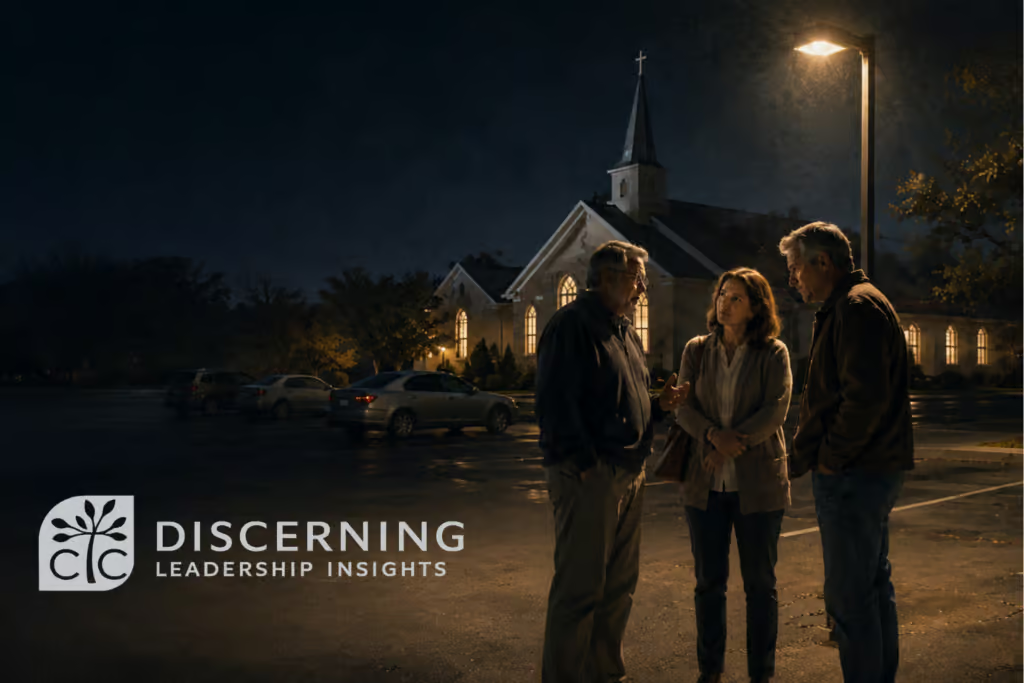
Trust is often noticed by where truth goes after the meeting.
Over time, I have come to listen not only to what is said during a meeting, but to where the truth seems to go afterward. When important concerns keep moving into hallways, parking lots, and private calls, the issue is rarely only communication. Often the room has not yet become trustworthy enough to hold what people are carrying.
Most church leaders know the parking lot meeting. The formal meeting ends. The minutes will show that the agenda was completed, the reports were received, and the motion passed. People gather their folders, stack their papers, offer polite goodnights, and walk toward their cars. Then the more honest conversation begins. Someone says what they almost said at the table. Someone wonders whether the decision was made too quickly. Someone names the concern they did not want to raise in front of the pastor, the treasurer, the chairperson, or the person whose ministry was being discussed. Someone asks, “Did that feel right to you?”
The parking lot conversation is not always a sign of bad intent. Often it is the place where people finally have enough space to process what the meeting could not hold. They may not be trying to undermine the board. They may be trying to tell the truth in the only place that feels safe enough. But when the most honest conversation regularly happens after the meeting, the governing body has lost something important. The truth needed for discernment has left the room where discernment and decision-making are supposed to happen.
Trust changes what a governing body can carry.
In healthy governance, trust is the formed confidence that truth can enter the shared work of leadership without threatening belonging. A question can be asked without being treated as resistance. A concern can be named without being labeled negativity. A financial reality can be spoken without fear becoming the governing voice. Disagreement can remain relationally grounded. Trust gives leaders enough steadiness to listen for Calling while also receiving the actual condition of the church.
Churches often use the language of trust to mean that people care about one another. That matters. Many church leaders genuinely love their congregations, respect their fellow board members, and want to serve faithfully. Good intentions give the work a beginning place. They do not, by themselves, create the conditions needed for discernment. People can care deeply and still participate in systems that make honesty difficult. A board can have warm relationships and still lack clarity about authority. A council can respect the pastor and still avoid naming the emotional labor being carried by one person. A finance committee can be diligent and still present information in ways that keep the governing body from seeing what the numbers are revealing.
Trust in governance has a practical shape. People know how decisions are made. They know who has authority to recommend, decide, and implement. They know how concerns can be raised. They know whether disagreement will be received as care for the body or as disruption. They know whether minutes accurately record what happened, whether follow-up will happen, whether reports are offered in time to be received, and whether difficult information will be handled with maturity. These practices may seem ordinary, yet they shape the emotional atmosphere in which discernment either deepens or retreats.
That distinction shapes the spiritual capacity of the governing body. A church can say it values discernment, prayer, and shared leadership while still organizing its meetings in ways that make truth hard to tell. When people are unsure how concerns will be received, they spend part of their attention managing themselves. They calculate. They soften. They wait for cues. They listen less for the Spirit because they are listening so carefully for risk.
You can feel trust before anyone defines it. People speak with a little less calculation. A newer board member can ask why a practice exists and be met with explanation rather than irritation. Someone can say, “I do not understand what we are being asked to decide tonight,” and the group can slow down without embarrassment. A chair can pause the meeting and say, “Before we move on, I want to make sure we have heard what was just raised.” A pastor can let the board sit with discomfort without having to absorb the whole emotional reaction alone. Trust is present when these moments become invitations to clearer listening rather than tests of loyalty or competence.
One way to understand this is through the relationship between Calling, Energy, and Resources. Calling names the deeper invitation a church is being asked to serve in a particular season. Energy names what is actually alive in the body: willingness, fatigue, joy, resistance, grief, imagination, and capacity. Resources name what has been entrusted for faithful response: money, property, people, systems, trust, authority, and time. Healthy discernment listens across all three. It asks what God is inviting, what the body can honestly carry, and what has been entrusted for faithful action.
Trust is what allows those questions to be answered truthfully. A church can have a beautifully worded mission statement and still struggle to tell the truth about Energy. It can have accurate financial statements and still avoid asking what the numbers reveal about Calling. It can have capable leaders and still operate with enough unspoken anxiety that every difficult conversation becomes a test of loyalty. Trust allows the church’s actual life to become part of discernment. It helps leaders stop making decisions for the imagined congregation and begin listening with the real one.
When trust is low, its absence often appears in small governance habits before it shows up as open conflict. Agenda items are vaguely named so the real issue does not appear too starkly. Committees bring polished updates that hide their struggles. Decisions are made informally before the meeting because the formal conversation feels unpredictable. Newer board members remain quiet because they are still learning what the room permits. Concerns are carried into the parking lot because the meeting itself did not feel able to hold them.
People are usually trying to keep the church steady. They have seen conflict wound communities. They know how easily financial stress can unsettle people. They do not want to dishonor volunteers who have given years of faithful service. They want the pastor to feel supported. They want the meeting to end with relationships intact. The desire to protect the body is understandable. Yet when protection requires too much silence, the body slowly loses its ability to discern.
Trust grows when leaders no longer have to wonder whether the process itself can be trusted. Clear agendas, timely reports, accurate minutes, transparent financial information, defined authority, reliable follow-up, and honest communication about what has and has not been decided all reduce emotional guesswork. People can spend less Energy wondering what is hidden, who is responsible, whether the decision is real, or whether a concern will be received. Faithful structure gives the room more freedom to listen.
Role clarity carries spiritual weight for the same reason. When people do not know where authority lives, they begin reading the room for clues. They listen for tone, history, preference, and informal power. A committee may think it has made a decision when it has only made a recommendation. A board may assume the pastor will handle a concern that properly belongs to the governing body. A chairperson may try to hold together confusion that could have been prevented by naming the decision pathway earlier. Trust deepens when people know what responsibility they carry and what responsibility belongs elsewhere.
The chairperson has an important role in tending this atmosphere. The chair does not create trust alone, and trust never belongs to one office. Still, the way a chair holds the room teaches people whether the room can hold truth. A chair can slow the conversation when anxiety begins to rush the group toward closure, ask what has not yet been named before a decision is made, notice when one voice is carrying too much weight, and clarify whether the board is receiving information, entering discernment, making a decision, or assigning follow-up. These small acts help the group trust the process enough to participate more honestly.
Trust also grows through repair. No governing body handles every conversation well. People speak too quickly. Concerns get missed. A decision is communicated poorly. A meeting moves ahead before the board has listened deeply enough. In low-trust systems, these moments often disappear into silence. People hope time will soften them. The next meeting begins as if nothing happened, while the unresolved moment continues shaping how people participate.
I have seen trust become visible when a board member interrupted another member during a difficult conversation. The interruption changed the direction of the discussion. Later in the same meeting, the second board member noticed what had happened, named it without defensiveness, and invited the first board member to finish their thought so the decision could be more fully informed. It was not a dramatic moment. It did not require a speech. But something important happened. The board corrected its own process before the truth was lost.
That kind of repair helps keep truth from migrating to the parking lot. A mistake can be named without becoming a permanent accusation. A voice that was cut off can be returned to the conversation. The group can acknowledge that process affects discernment, and that the way a decision is reached shapes the decision itself. Trust deepens when people learn that difficult moments do not have to disappear into private resentment or hallway conversations. They can be brought back into the shared work.
Trust also changes the relationship between disagreement and belonging. In low-trust environments, disagreement is often treated as a relational risk. People hesitate because they do not want to appear negative, disloyal, difficult, or unsupportive. They may support a decision publicly while carrying concern privately. They may let a conversation move forward because challenging it would cost too much relationally. The church may preserve the appearance of unity, while the real work of discernment has moved underground.
In healthier governance, disagreement can remain connected to love. A board member may question a proposal because the ministry matters. A treasurer may raise financial concern because the church’s future matters. A pastor may name a pattern because the board’s spiritual health matters. A quieter leader may hesitate before speaking, then offer the sentence no one else has found the courage to say. Trust helps the room receive these moments as part of the body’s care for itself.
There is a particular kind of steadiness that emerges when trust has been formed over time. The meeting may still be hard. The budget may still be limited. A ministry may still need to be released. A building may still require decisions the congregation has delayed for years. Yet the governing body begins to feel less governed by fear. People can name what is true. They can disagree without losing one another. They can ask whether the Spirit is inviting the church toward something that will require courage. They can admit uncertainty without treating uncertainty as failure.
This steadiness protects discernment. It gives the governing body enough transparency, formation, and process integrity to stay present when truth becomes uncomfortable. Discernment remains the root. Calling remains the center. Governance becomes one of the ways the church protects the conditions needed for listening. Trust helps create the kind of environment where truthful attention can last long enough to become faithful response.
A church begins to trust its governance when truth can enter the shared work of leadership and still find people willing to remain together before God. The truth may arrive as an unfinished report, a difficult question, a missed follow-up, a misunderstood decision, or a silence that asks to be treated with care. Healthy governance does not make these moments painless. It gives the body a way to carry them without fleeing into avoidance, control, politeness, or blame.
Trust is built slowly. Through meetings where people do what they said they would do. Through reports that tell the truth clearly. Through chairs who slow the room when needed. Through pastors who do not have to carry every emotional reaction alone. Through treasurers who help the board see reality without making fear sovereign. Through board members who risk honest questions and discover that the room can receive them. Through repair after moments that could have hardened into resentment.
When trust takes root, governance begins to feel less like a guarded exchange of information and more like a community practicing faithful attention. The church still has decisions to make. It still has budgets, buildings, bylaws, ministries, and responsibilities. But the room can carry more truth. And because it can carry more truth, it can listen more deeply for the Spirit.