
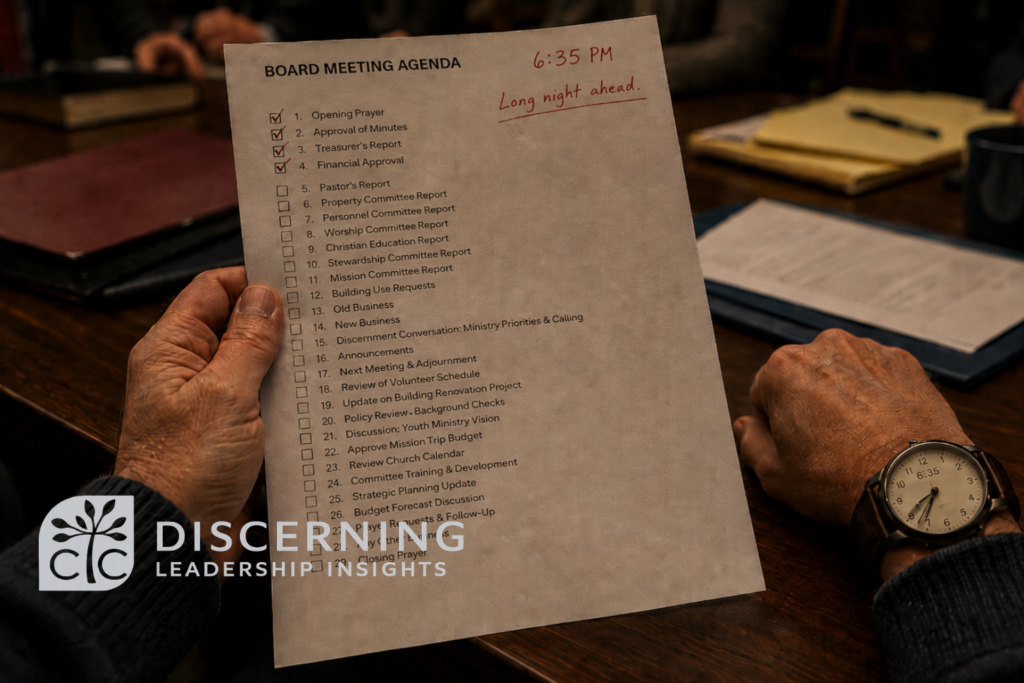
We have all been in a meeting that runs too long. The agenda was planned to fit within the expected timeframe, and everyone arrived assuming the group would move through the work with reasonable care. Then one item needed more attention than expected. A financial concern raised questions no one had prepared to answer. A personnel matter required more discretion and patience than the agenda allowed. A building issue uncovered a larger question about priorities, authority, and cost. The meeting stretched past the hour people had given to it, and by the end, even thoughtful leaders were watching the clock, shortening their comments, and hoping the remaining items would move quickly.
This happens sometimes. When people gather and open up a new conversation, it can raise concerns, trigger emotion, and reveal other matters that have not yet been named. There are times a meeting will go beyond the time allotted, or a topic will need to be tabled for a future meeting so the group has enough time to discuss it with the care it deserves. This should be an occasional occurrence, not a pattern the church learns to live inside. Agendas should anticipate discussion and provide enough room for the unexpected. When they do not, the meeting begins creating exhaustion before leaders have reached the questions that require discernment.
The problem develops when long meetings become normal, packed agendas become expected, and leaders begin assuming that exhaustion is simply part of serving on the board. The meeting runs long because the agenda was crowded from the beginning, routine reports were given more time than they required, and the most important matters were placed after the room had already spent its attention. Over time, the agenda itself becomes one of the ways the church drains the energy needed for faithful listening.
Chronic exhaustion alters perception. It narrows what leaders can notice and reduces the emotional space available for interpretation. A tired board may hear a faithful invitation as a burden. A weary committee chair may experience a necessary question as criticism. An overextended volunteer may respond to a new possibility by immediately calculating who will be asked to do the work. These reactions do not mean the people involved are unfaithful. They reveal that the conditions under which they are being asked to listen have become too thin for the depth of discernment the church requires.
You can hear this exhaustion in the language of meetings. “Folks, this item is too important to table again.” “I am tired of talking about this.” “We already have too much on our plate.” “I do not see how we would accomplish this.” Each statement may be honest and appropriate in the moment. Together, they reveal a leadership body whose available energy has become one of the strongest forces shaping what it can hear.
Fatigue is often produced by the ordinary design of church leadership life: meeting rhythms, agenda design, reporting practices, bylaw-required committee structures, unclear volunteer roles, weak delegation, poor information flow, lack of onboarding, unfinished follow-up, inherited programs, and crisis-driven decision-making. Each can drain energy in its own way. The patterns most often felt in board and council meetings are packed agendas, required committees the congregation can no longer sustain, unclear roles, report-heavy meetings, weak authority boundaries, and the absence of a clear process for evaluating what should continue, change, or be released.
Agendas are often the first place exhaustion becomes visible. Many boards begin with prayer and then move through approval of minutes, finance, property, personnel, worship, Christian education, stewardship, mission, building use, unfinished business, new business, and several items that were tabled the month before. Each item may have a legitimate place in the life of the church. Together, they create a meeting where leaders spend most of their energy receiving updates and managing decisions, with little space left for prayerful interpretation. By the time the board reaches the matter that most needs discernment, the room has already spent its best attention.
The placement of agenda items teaches the room what matters. When routine updates receive the same amount of space as spiritually significant questions, the board is trained to treat all agenda items as equal. When a discernment question is placed near the end of the meeting, leaders approach it with diminished patience and a rising awareness that people need to get home. When every committee chair is invited to speak, even when the update could have been sent in writing, the board’s energy is consumed by recitation before it ever reaches interpretation. The agenda may look orderly on paper while quietly exhausting the people gathered around it.
Committee structure creates another form of fatigue. Many churches still operate with bylaws written for a larger congregation with more members, more volunteers, and more available leadership energy. The bylaws may require finance, property, worship, personnel, mission, Christian education, stewardship, nominations, and additional teams or task groups. In an earlier season, that structure may have matched the size and energy of the congregation. In the current season, the same structure may require the same few people to serve in three or more places simply to keep the organization functioning.
This overextension often hides beneath the appearance of order. On paper, the church still has committees. The reports are still submitted. The meetings still happen. The calendar still reflects a functioning organization. Yet the same names appear again and again. One person serves on council, finance, and property. Another serves on worship, stewardship, and nominations. The pastor attends more committee meetings than the congregation realizes. The committee chart looks complete, while the people holding it together are being steadily depleted.
Unclear roles add to the strain. Some churches ask people to accept substantial responsibility with little clarity about what the role includes. A committee chair is told to “coordinate the work.” A board officer is elected with little orientation beyond what the previous person happened to share. A ministry leader inherits expectations that live mostly in institutional memory. In some cases, there is no written position description at all. Confusion follows naturally. People duplicate effort, miss responsibilities, revisit decisions, and carry anxiety about whether they are doing enough.
Ambiguity consumes energy. A volunteer who knows what is expected can serve with greater steadiness. A volunteer who has to guess will either over-function, under-function, or constantly seek reassurance. A board with clear authority boundaries can focus on the questions entrusted to it. A board without those boundaries may find itself discussing matters that belong to staff, committees, or individual ministry leaders. Meeting after meeting, the same questions return because the church has not clarified where responsibility rests.
Committee reports create their own kind of depletion when they dominate the meeting. Many churches have inherited the assumption that every committee should report to the board every month, preferably aloud, whether or not there is anything significant to interpret. The property committee reports that the repairs were completed. Worship reports that the schedule is set. Christian education reports attendance. Mission reports an upcoming collection. Finance reviews the numbers. Each report may be short, but together they claim the room’s attention before the board has done the deeper work of asking what the reports reveal about Calling, Energy, and Resources.
When reports dominate the meeting, leaders can mistake being informed for discerning together. A board can hear ten reports and still fail to ask what those reports are revealing. Where is energy increasing? Where is energy fading? Which ministries are being sustained by joy, and which are being sustained by obligation? Which responsibilities are aligned with Calling, and which ones continue because no one has created a process for release? These questions require time, attention, and spiritual space. A meeting consumed by reports leaves little room for them.
Authority boundaries matter as well. When a board has to approve every small expenditure, every building use question, every minor scheduling change, or every operational adjustment, it spends its energy on matters that could be handled elsewhere with clear guidelines. When committees do not know what they are authorized to decide, they bring matters back to the board repeatedly. When staff roles and board roles blur, leaders revisit the same concerns from multiple angles without clarity about who should act. This kind of structure makes exhaustion feel like diligence because everyone is involved in everything.
Follow-up practices can drain a board in a quieter way. When the same item appears month after month with no clear owner, deadline, or decision status, the group feels as though it is always returning to unfinished ground. Leaders lose energy rehearsing what was already discussed, trying to remember who agreed to do what, and clarifying whether the matter is still open. A simple decision log, clear assignments, and honest tracking of next steps can protect attention. Without them, fatigue accumulates through repetition.
Information flow shapes exhaustion too. When reports arrive too late, leaders spend the meeting trying to understand material they should have received earlier. When reports are too vague, the board fills in the gaps with assumptions, anxiety, or side conversations. When reports are too detailed, the actual discernment question gets buried under operational information. A board needs enough information to interpret reality, and the timing, clarity, and purpose of that information matter.
Crisis-driven decision-making creates another layer of fatigue. Some churches delay hard conversations until the matter becomes urgent, then gather leaders under pressure and ask them to make decisions quickly. A staffing concern waits until morale is already strained. A building issue waits until the repair is unavoidable. A financial concern waits until reserves have already been drawn down. The board then experiences every major decision as an emergency. Over time, urgency becomes the rhythm of leadership, and adrenaline replaces discernment.
Evaluation and release practices may be the most tender part of this work. Many churches have no clear process for asking whether a program, event, committee, or practice still belongs to the congregation’s Calling. Ministries continue because they have always continued. Committees remain because the bylaws list them. Events happen because people remember when they mattered deeply. Without a process for evaluation, the church relies on fatigue to tell it when something can no longer be carried. By then, resentment may already have begun to form.
Over time, these patterns change the emotional character of leadership. Irritability rises more quickly. Imagination feels expensive. Questions begin to feel like obstacles. Suggestions from newer leaders are received with weariness because every suggestion seems to imply more labor. People begin protecting themselves from hope because hope has become associated with another assignment, another committee, another meeting, or another responsibility added to an already crowded life. The church may remain cordial, but its generosity becomes thinner.
This is where exhaustion begins to compress discernment. Discernment requires spaciousness, and depleted structures rarely create spaciousness. They may keep decisions moving, but they weaken interpretation. They may maintain programs, but they reduce the capacity to ask whether those programs still align with Calling. They may approve budgets, but they often leave little room to ask what the budget reveals about attachment, fear, capacity, and mission. The church continues doing the work in front of it while losing access to the deeper listening beneath the work.
Calling becomes harder to hear when the board is organized around survival and completion. The board wants to finish the agenda. The chair wants to keep the meeting from running late. The pastor wants to avoid adding strain to leaders who are already overextended. Volunteers want to know who will do the work. The congregation wants familiar ministries to continue, even when the people sustaining them are worn down. In that environment, a question of Calling may sound impractical because the church no longer has enough energy to imagine faithful response without immediately translating it into burden.
This matters for the whole ecosystem of discernment-rooted governance. Discernment is the root, and roots require conditions that support life. Calling stands at the center, but Calling must be received by people with enough attention to hear it and enough energy to respond. The branches include authority, accountability, information flow, role clarity, and decision-making. The leaves include the emotional conditions that make patience, honesty, and reflection possible. Chronic exhaustion affects the entire ecology. It drains the energy needed for faithful listening while the visible structure may still appear intact.
Energy is not a secondary concern in Calling, Energy, Resources. A church may have a meaningful Calling and adequate financial resources while lacking the human energy to carry the form of ministry it has inherited. Another church may have willing people, but its bylaws, agenda habits, committee structure, reporting expectations, role ambiguity, and crisis patterns may be scattering their energy across too many obligations. A faithful board has to ask about energy with the same seriousness it brings to money, mission, and structure.
A healthier structure begins by treating exhaustion as spiritual data. It asks what the fatigue is revealing about Calling, Energy, Resources, and leadership design. It notices when board agendas consistently leave no room for discernment. It notices when people serve on three committees because the bylaws still require a structure the congregation can no longer sustain. It notices when volunteers are confused because there is no clear role description. It notices when meetings are filled with spoken reports that drain the room before the real conversation begins. It notices when unfinished matters return without ownership, when information arrives too late, and when urgent decisions reveal conversations that should have begun earlier.
The work begins with concrete changes. The agenda may need fewer items, clearer priorities, and intentional space for discernment before fatigue takes over. Routine committee reports may need to be submitted in writing so meeting time can be used for interpretation instead of recitation. The bylaws may need revision so the committee structure matches the actual size and energy of the congregation. Volunteer positions may need written descriptions that clarify responsibility, authority, and expected time commitments. Board policies may need to define what committees and staff are authorized to decide without bringing every matter back to the full board.
Churches also need the courage to release what they can no longer carry faithfully. This may include a committee that no longer serves a clear purpose, a reporting pattern that consumes time without generating wisdom, a program sustained mostly by guilt, or a bylaw requirement inherited from a different era. Releasing these things can feel like loss because structures accumulate memory and meaning. Yet truthful release is part of faithful stewardship. A church can honor what once served it well while acknowledging that the same structure now drains the energy needed for present Calling.
Pastors cannot hold this alone. Many pastors absorb the fatigue of the structure because they are the one person who sees the whole. They know which leaders are overextended, which committees are struggling, which responsibilities are unclear, and how much of the church’s life is being sustained by heroic effort. A healthier board makes exhaustion a shared matter of discernment. It asks what the pastor is carrying, what volunteers are carrying, what staff are carrying, and what the structure itself is producing.
The chair or moderator has a practical role in this work. The chair can notice when the room is too tired for the decision being asked of it. The chair can guard against agendas that promise more than the evening can hold. The chair can help distinguish between matters that require discussion and reports that simply need to be received. The chair can protect time for discernment early enough in the meeting that leaders still have the capacity to listen well. These are ordinary leadership practices, yet they determine whether the meeting becomes a place of spiritual attentiveness or a place of accumulated fatigue.
There is tenderness in this work because many exhausted leaders are exhausted from love. They have stayed late, answered emails, chaired meetings, counted offerings, unlocked buildings, prepared reports, and held institutional memory because the church matters to them. Any conversation about exhaustion has to honor that love. It also has to tell the truth that love can be misused by structures that keep asking the same people to carry more than they can bear.
A church that takes discernment seriously must take exhaustion seriously. It must ask how its agenda uses attention, how its bylaws distribute responsibility, how its committees consume or preserve energy, how its position descriptions clarify service, how its reporting practices either support interpretation or drain the room, and how its decision practices allow the church to act before everything becomes urgent. The goal is a church with enough spiritual and organizational capacity to hear the Spirit together. That capacity is cultivated through rhythms, structures, limits, and practices that honor the humanity of those who lead.
Discernment cannot survive chronic exhaustion because listening requires life. It requires leaders who can be present enough to notice, patient enough to wait, honest enough to tell the truth, and free enough to imagine faithful response. When a church listens to its exhaustion, it may hear more than complaint. It may hear an invitation to reorder its commitments, simplify its structure, clarify its responsibilities, release what no longer gives life, and protect the attentiveness through which the Spirit is heard.