
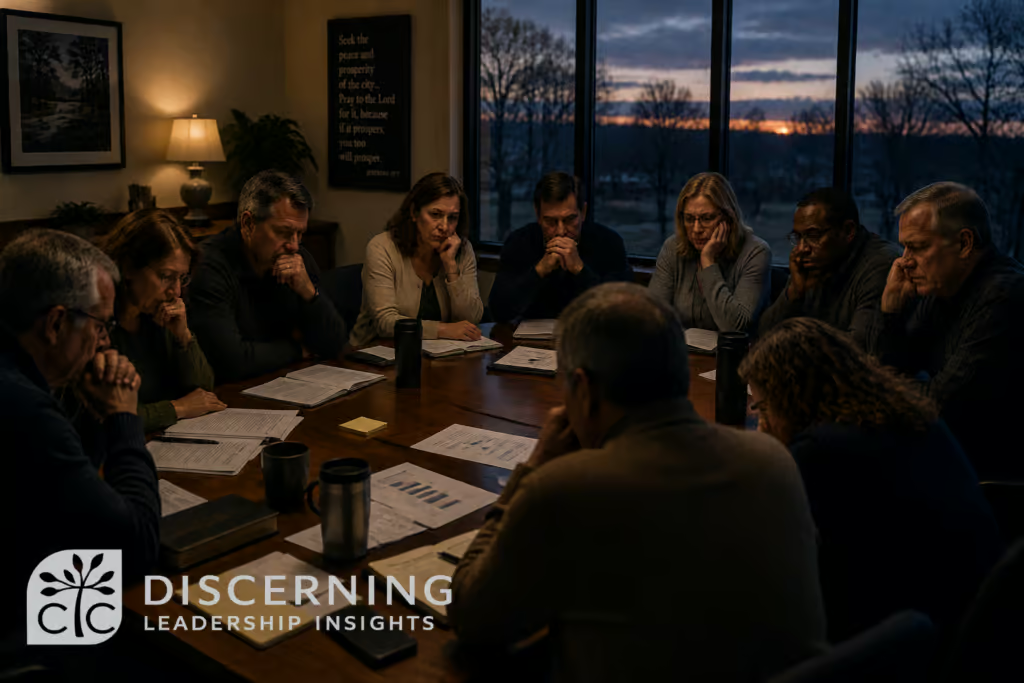
“I just wish we had more clarity.”
The sentence settled quietly into the room, and several people nodded in agreement. The governing board had spent most of the evening discussing staffing concerns, financial pressure, and the growing realization that some long-standing patterns in the congregation could not continue indefinitely. No one had raised their voice. No one appeared angry. In many ways, it was the kind of thoughtful and respectful meeting churches often hope to have. Yet beneath the calmness was a shared fatigue that everyone could feel but few could fully name.
When the board member spoke about clarity, the room relaxed for a moment. The statement sounded responsible and spiritually mature. It gave language to the discomfort everyone was carrying. But as I have reflected on moments like this over the years, I have become less certain that churches are always asking for clarity when they use that word. Often what communities long for is something closer to assurance. They want relief from the vulnerability of not knowing what comes next. They want confidence that the decisions ahead will not lead to conflict, loss, failure, or grief.
A few days ago, I watched a short reflection online about certainty and faith. The speaker argued that certainty begins to disappear when enough “why” questions are asked, and that this is not a threat to faith but the place where faith actually begins. I understood what he was trying to say. Much of contemporary culture teaches people to search for guarantees before they trust anything deeply. Churches are not immune to that instinct. Many congregations quietly hope discernment will eventually produce enough confidence to remove the emotional weight of uncertainty.
Still, I found myself lingering with the idea afterward because something about it felt incomplete. Faith matters deeply, but faith disconnected from discernment can become untethered from wisdom, community, and honest listening. Churches can convince themselves they are acting faithfully while being driven primarily by anxiety, urgency, institutional preservation, or the persuasive confidence of a strong personality. In those moments, faith becomes attached to emotional momentum rather than communal attentiveness to the Spirit.
I do not believe the deepest human need is certainty. At the same time, I am not convinced that perpetual ambiguity is spiritually mature either. Most people are not looking for exhaustive knowledge about the future. They are searching for enough clarity to take the next step with integrity. There is a meaningful difference between demanding certainty and receiving enough light to continue walking forward together.
That distinction becomes important in church governance because certainty and clarity do not feel the same emotionally. Certainty seeks resolution. It wants the path ahead to become fully visible before trust is required. Clarity is quieter than that. It usually emerges gradually through conversation, prayer, observation, honesty, and time. It rarely removes every question. More often, it creates a growing sense of alignment around what the community may need to face, release, or embrace next.
Several years ago, I worked with a congregation that had spent nearly two years debating whether to restructure their staffing model. Attendance had slowly declined, giving patterns had shifted, and the workload carried by a few exhausted leaders had become unsustainable. Every meeting circled the same questions. People wanted clearer projections, more certainty about outcomes, and reassurance that any changes would stabilize the church. What finally moved the conversation forward was not a strategic breakthrough or a sudden moment of confidence. It was a quieter realization that everyone already understood the current situation could not continue indefinitely. The clarity emerged slowly through honest acknowledgment rather than through certainty about the future.
Even then, the discernment process remained emotionally difficult. Some leaders grieved the loss of familiar structures. Others worried about how the congregation would respond. A few remained unconvinced that the changes would succeed. Yet over time, the board developed enough shared clarity to move forward together, even while many unanswered questions remained. Looking back, I do not think anyone involved would describe the experience as certainty. What they found instead was a deeper willingness to remain honest with one another and attentive to what the moment required.
Churches often struggle with this because institutional systems quietly reward certainty. Boards feel pressure to make confident decisions. Pastors learn that congregations are often more comfortable with strong answers than unresolved questions. Financial realities create urgency, and urgency narrows emotional space for patient listening. Under those conditions, leaders can begin feeling that they must sound certain in order to maintain trust, even when the actual discernment process feels incomplete or unsettled inside them.
Over time, this shapes the emotional atmosphere of governance. Conversations become more cautious. People hesitate to name uncertainty honestly because uncertainty is easily mistaken for weakness or indecision. Discernment then becomes compressed by the need for reassurance. Communities stop listening deeply because the emotional pressure to reach conclusions becomes stronger than the willingness to remain attentive.
This may be one reason discernment requires more than prayerful intention. It also requires structures and relationships capable of holding complexity without rushing prematurely toward resolution. Communities need emotional safety to speak honestly. They need enough trust to acknowledge competing interpretations and unresolved fears without immediately dividing into factions. They need enough patience to let clarity emerge gradually rather than forcing decisions simply to relieve anxiety.
In many churches, the most significant discernment does not arrive as sudden revelation. It develops slowly through accumulated attentiveness. A conversation begins to feel more truthful than previous ones. Resistance softens in unexpected places. A leader admits something difficult that others had quietly sensed for months. Grief surfaces alongside relief. The community notices that while many questions remain unanswered, there is growing honesty about what can no longer be avoided.
None of this removes uncertainty. In fact, some forms of discernment seem to deepen awareness of how much cannot be controlled. Yet there is often a subtle difference between uncertainty shaped by fear and uncertainty shaped by surrender. One produces panic and reactivity. The other allows people to remain present, attentive, and grounded even when outcomes remain unclear.
Perhaps this is why mature discernment rarely feels triumphant. It is usually more modest and human than that. People continue carrying concerns, limitations, and unanswered questions. The future does not suddenly become predictable. What changes instead is the community’s relationship to uncertainty itself. There becomes enough shared clarity to continue walking together without demanding guarantees before trust is possible.
I continue thinking about that board member’s comment: “I just wish we had more clarity.” I suspect many churches are carrying that same longing right now. Beneath budget conversations, staffing discussions, and strategic planning sessions is often a quieter desire to know whether there is enough light to take the next faithful step without losing themselves in the process.
Perhaps discernment has never promised certainty in the way many of us quietly hope it will. Perhaps its deeper gift is something gentler than that — the gradual formation of communities capable of listening honestly, moving carefully, and remaining open to the Spirit even when the road ahead can only be seen a few steps at a time.