
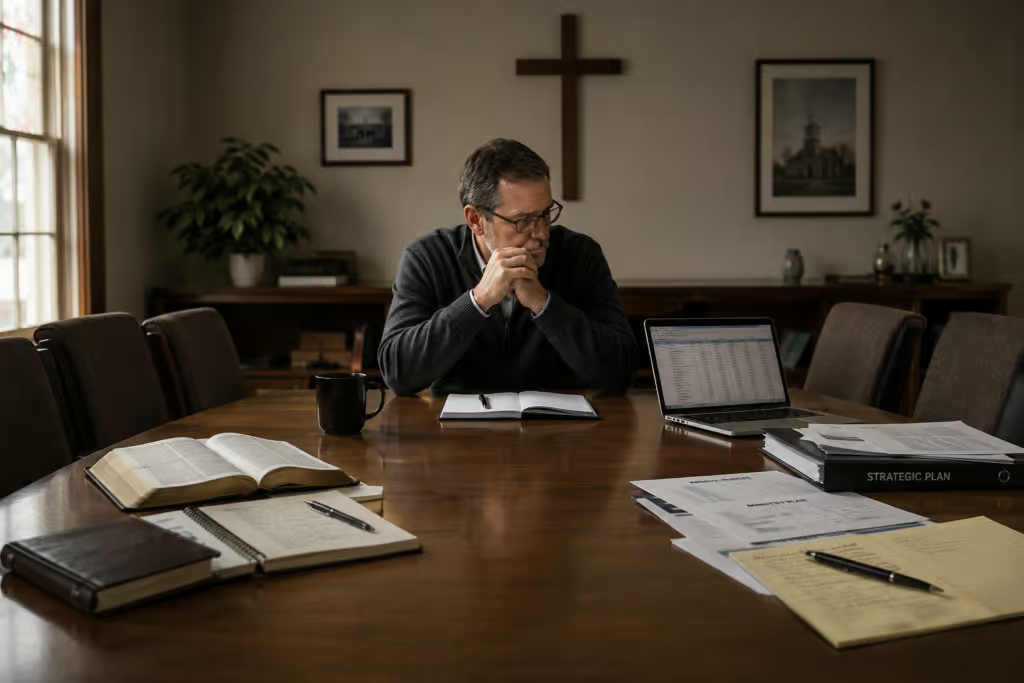
In many congregations, the expectations placed on pastors have shifted quietly over the past decade. Words like strategy, alignment, governance, sustainability, and organizational clarity are used with increasing frequency in board meetings and denominational conversations. Churches feel the weight of complexity. Cultural volatility, financial pressure, and declining volunteer bases have made leadership feel more urgent.
Yet when pastors describe their own sense of calling, they often use different language.
A recent Barna study found that fewer than one in four pastors primarily identify themselves as leaders. Most describe their role as teacher or preacher.¹ That distinction is more than semantic. It reveals a gap between how pastors understand their vocation and how many congregations now function.
In previous generations, the pastoral role carried clearer boundaries. The pastor preached, visited the sick, moderated meetings, and provided theological direction. Lay leaders oversaw governance and stewardship. Those lines were not perfect, but they were recognizable. Today, those boundaries have blurred. Many congregations expect the pastor to function as chief integrator—holding together vision, finances, staffing, conflict resolution, and external representation—while also maintaining spiritual depth and relational availability.
This expectation rarely arrives as a formal job description. It accumulates over time.
A board asks the pastor to “set direction” for the coming year. A finance team seeks interpretation of giving trends and staffing implications. A conflict between ministry teams requires mediation. A denominational shift demands careful navigation. None of these tasks are inappropriate in isolation. Together, they form a leadership portfolio that resembles executive responsibility.
For a pastor who entered ministry drawn by Scripture, sacrament, and shepherding, the shift can be disorienting.
One pastor shared with me that he began to notice tension in subtle ways. He would prepare thoroughly for preaching and pastoral care, only to find that most of his week was consumed by staffing questions, insurance renewals, and meeting facilitation. When a board member asked why he was not providing a more aggressive growth strategy, he felt momentarily exposed. He had not thought of himself as the architect of institutional expansion. He saw himself as a spiritual guide within a shared leadership body. “I realized,” he said, “that they assumed I was steering the whole ship.”
That assumption is not unusual. Hartford Institute research conducted during and after the pandemic found that clergy cited declining attendance, resistance to change, and administrative pressures as major stressors.² Even as more recent data suggests signs of congregational rebound in attendance and volunteer participation,³ the expanded complexity of pastoral leadership has not simply receded. Once roles stretch, they rarely contract on their own.
What emerges is a structural mismatch. Boards may expect leadership clarity and decisive direction. Pastors may expect collaborative discernment rooted in theological reflection. When those expectations are not named, frustration grows quietly on both sides. Boards can perceive hesitancy where pastors feel faithfulness. Pastors can experience pressure where boards believe they are offering support.
The strain is often internal before it becomes visible.
A pastor who does not instinctively identify as a leader in the organizational sense may begin to question competence. Am I failing to lead? Should I be more assertive? Do I need training I never received? At the same time, board members may feel uncertain about their own authority. If the pastor is not driving governance, who is?
These questions point to design, not character.
Many congregational governance models were inherited from periods when membership was larger and volunteer capacity more abundant. Committees once distributed responsibility across dozens of engaged lay leaders. As participation declines or fluctuates, decision-making compresses. The pastor becomes the most consistently present and therefore the default integrator of unresolved issues.
This compression does not require crisis to occur. It happens through small adaptations. A committee dissolves. A treasurer steps down. A volunteer coordinator role goes unfilled. The pastor temporarily absorbs the gap. Temporary measures solidify into normal practice.
Over time, the pastor’s role shifts from spiritual leader within a system to primary stabilizer of the system.
The difficulty is that few congregations pause to revisit how the role has evolved. Job descriptions remain static while expectations expand. Annual evaluations assess outcomes without revisiting design. Meanwhile, pastors carry both the visible and invisible dimensions of leadership.
It is worth noting that recent Hartford research reports improved clergy well-being in several domains and signs of congregational recovery.³ This is encouraging. It suggests that decline narratives do not tell the whole story. However, recovery does not automatically resolve role ambiguity. In some contexts, renewed attendance and volunteer engagement may even intensify expectations for strategic growth and visionary leadership.
The question, then, is not whether pastors should lead. They do. The question is whether congregations have clarified what kind of leadership is being asked of them, and whether that expectation aligns with the pastor’s formation, gifts, and support structures.
Healthy governance requires explicit conversation. Boards benefit from articulating their own responsibilities clearly rather than assuming pastoral primacy in every domain. Pastors benefit from naming how they understand their calling and where they may need shared leadership or additional development. When these conversations occur proactively, misalignment becomes less likely to calcify into resentment.
This is not a call to professionalize ministry into corporate leadership. It is an invitation to acknowledge the complexity of modern congregational life. Churches are no longer simple organizations. They manage property, finances, digital communication, personnel policies, and community engagement within an increasingly regulated environment. Pretending that the pastoral role remains unchanged does not serve either the shepherd or the congregation.
If pastors are expected to lead, they deserve to be recognized, supported, and formed as leaders. If boards expect shared governance, they must inhabit that responsibility fully. The alternative is quiet drift, where expectations expand and identity lags behind.
Perhaps the most helpful starting point is a simple question raised in the right setting: How do we understand the pastoral role in this season of our life together? The answer may reveal assumptions that have never been spoken aloud.
When those assumptions are brought into the open, clarity becomes possible. And clarity, more often than urgency, is what sustains leadership over time.
Sources
- Barna Group. Unleashing the Church Through Lay Leadership. 2024.
https://www.barna.com/research/unleashing-the-church-through-lay-leadership/ - Hartford Institute for Religion Research. Post-Pandemic Burnout in U.S. Clergy (Exploring the Pandemic Impact on Congregations Project). 2024.
https://www.columbian.com/news/2024/jan/27/u-s-pastors-struggle-with-post-pandemic-burnout/ - Hartford Institute for Religion Research. Signs of Rebound Amid Uneven Recovery: The Changing Congregational Landscape. 2026.
https://www.hartfordinternational.edu/news-events/news/hirr-report-shows-first-rise-us-congregation-attendance-25-years-uneven-recovery/