

“For just as the body is one and has many members… so it is with Christ.” — 1 Corinthians 12:12 (NRSVue)
There is a kind of seeing a pastor must learn—before strategies, before agendas, before the next round of decisions.
Not seeing as diagnosis.
Not seeing as judgment.
Not seeing as the subtle urge to “fix” what feels tense.
Seeing as patient noticing.
Because a congregation is not a machine to optimize or a program to manage. It is a living body. It breathes. It expands and contracts. It stores memory. It responds to pressure. When one function dominates, another weakens. When the parts mature together, the body strengthens.
Paul’s image of the body is not sentimental. It is practical. Bodies have circulation, nourishment, boundaries, rest, growth, and repair. When one function collapses, the whole body compensates. Over time, compensation becomes strain.
And much pastoral exhaustion does not come from opposition. It comes from misreading the body.
If we cannot read the congregation’s vital signs, we begin to mistake symptoms for causes. We push when restraint is needed. We prune when growth is required. We add structure when what is missing is clear outward embodiment. And the body reacts—not because it is “resistant,” but because it is alive.
So what does faithful seeing look like?
A simple lens: the Rhythms of Congregational Life
One way to grow in this kind of noticing is to learn the recurring movements through which a congregation stays alive and aligned. Not programs. Not stages. Rhythms.
Five rhythms show up again and again:
Growth
Witness
Sustainability
Clarity
Discernment
When these rhythms mature together, the congregation lives in congruence—a faithful fit between Calling and lived shape. That lived fit is Integrity: not moral perfection, but a coherent life that matches what God is asking.
This is not a grading tool. It is a noticing tool.
The question is not, “Are we good at all five?”
It is, “What is primary now—and what gentle steadying is needed?”
A quick note on two terms you’ll see below: Structure names roles, decisions, boundaries, and next steps. Cadence is a repeatable rhythm that protects capacity over time.
How to use this field guide
When you are reading a situation:
Name the primary rhythm you’re seeing.
Ask what likely gave birth to it.
Ask what rhythm must now bring gentle steadying (right measure—so strain doesn’t build).
Make one small Structure or Cadence adjustment.
Re-observe in four to eight weeks. If nothing shifts, do not force harder. Return to noticing. The first read is often wrong.
Notice the gentleness built into the method. This isn’t pressure. It’s pastoral patience—trusting that patterns take time.
The sequence that often repeats
These rhythms tend to mature in a repeating pattern:
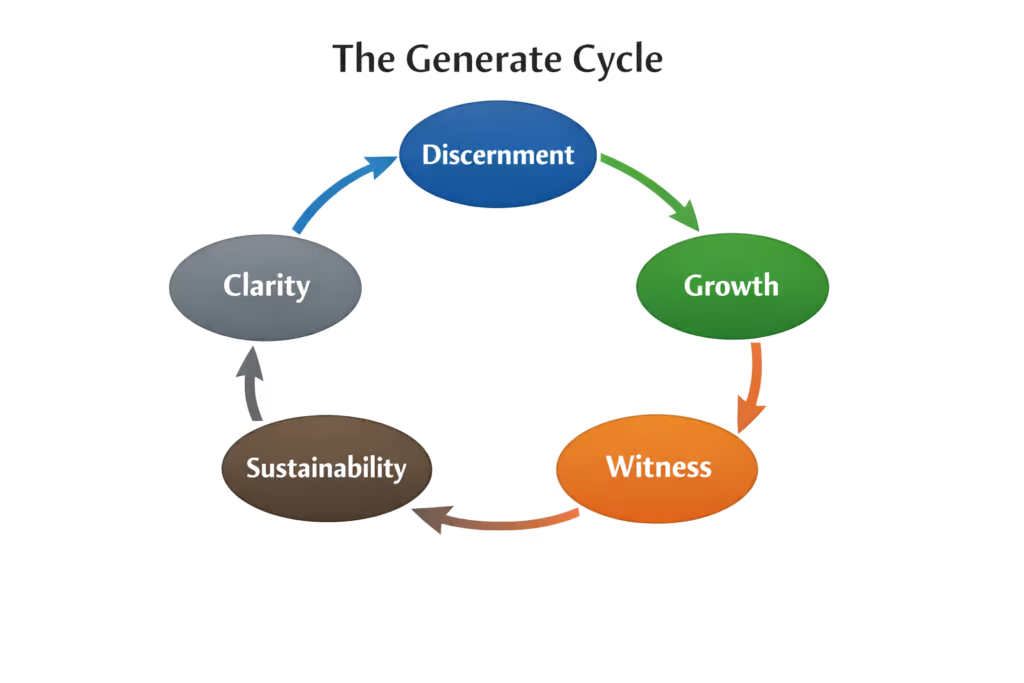
Growth ripens into Witness because new life naturally expresses outward.
Witness invites Sustainability because visible purpose draws shared commitment and investment.
Sustainability makes Clarity possible because endurance requires defined priorities, roles, and boundaries.
Clarity deepens Discernment because reduced confusion creates space to listen more deeply.
Discernment generates Growth because listening reveals what is ready to emerge.
But the rhythms also protect one another by gentle steadying “two steps away”:
Growth steadies Sustainability, so preservation doesn’t harden into fear.
Sustainability steadies Discernment, so listening doesn’t become endless delay.
Discernment steadies Witness, so outward life isn’t driven by urgency or performance.
Witness steadies Clarity, so governance doesn’t fold inward and become control.
Clarity steadies Growth, so expansion doesn’t scatter energy or exceed Capacity.
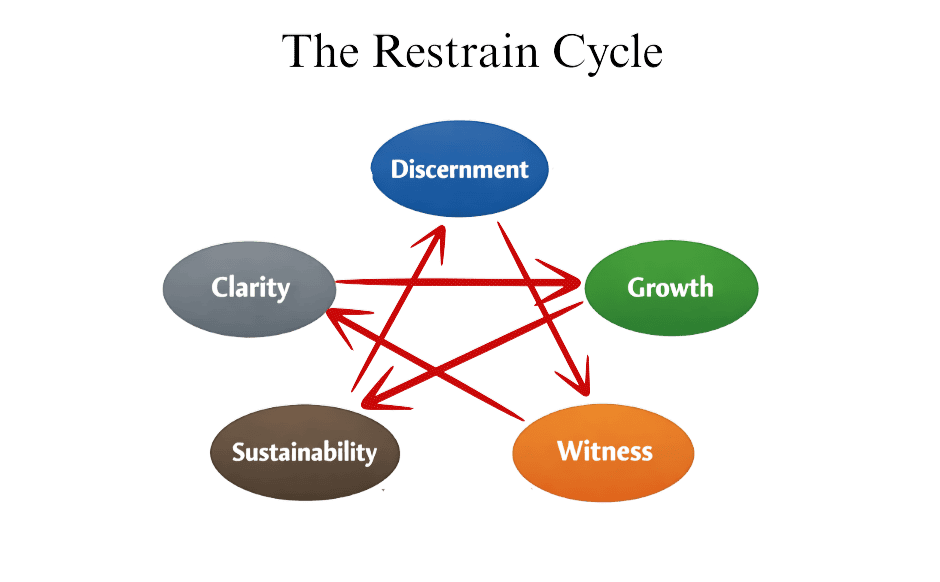
Right measure is not suppression. It is care. It is the body protecting itself from harm.
A brief story: when the first read is wrong
A council once believed it had a Clarity problem. Meetings were messy. Decisions kept returning. The pastor tightened agendas, created new templates, and clarified motions.
Nothing improved. Frustration grew.
Then two repeated details became impossible to ignore: volunteer participation was thinning, and pastoral care requests were increasing.
The problem was not Clarity first. It was Sustainability depletion. The body was tired.
When the calendar was lightened and a few responsibilities were released, meetings became clearer without new rules. Clarity returned because Capacity returned.
The lens didn’t fail. The first read did. This is why we remain gentle.
The five rhythms, in lived language
Growth
Growth is the congregation learning and maturing into its Calling—new life, deeper roots, healthier participation. Growth is not always “more.” Growth can look like depth: stronger formation, healthier leadership, fewer initiatives with greater fruit.
You’ll notice Growth in repeated details like:
people seeking deeper formation or shared learning
new relationships taking root (not just new attendance)
new possibilities emerging with genuine energy, not only pressure
Growth goes sideways as expansion without focus—ideas multiplying faster than Capacity.
Gentle steadying: Clarity
Try one small Structure practice: no new initiative is approved without a named leader and a three-month scope.
Four to eight weeks later, fewer ideas move forward—but those that do are carried with steadier energy. The body is not smaller. It is more coherent.
Witness
Witness is the outward expression of Calling—service, hospitality, justice, proclamation, presence beyond the congregation. Witness is not a campaign. It is expression that has ripened.
You’ll notice Witness in repeated details like:
concrete stories of impact beyond the church
community presence that feels natural rather than frantic
budget decisions that reflect outward purpose
Witness goes sideways as activity without listening—outward motion driven by urgency.
Gentle steadying: Discernment
Try one small Cadence: a quarterly Discernment check before launching anything new outward.
Four to eight weeks later, fewer initiatives are launched, but the ones chosen feel clearer and more shared. Witness remains alive—without strain.
Sustainability
Sustainability is the congregation’s capacity to endure faithfully—finances, volunteers, buildings, systems, calendar margin, and the ability to decide without collapse.
You’ll notice Sustainability in repeated details like:
volunteer roles that rotate, with rest normalized
budgets shaped by long-term reality
leaders who can breathe
Sustainability goes sideways as preservation without courage—stability hardening into avoidance.
Gentle steadying: Growth
Try one small Structure: a time-limited pilot initiative with a clear end date and one simple evaluation question tied to Calling.
Four to eight weeks later, energy rises—not because anyone forced it, but because the body feels safe enough to try one faithful step.
Clarity
Clarity is structural definition—roles, priorities, decisions, boundaries, and next steps. Clarity is not communication style. It is shared coherence that allows a body to move without confusion.
You’ll notice Clarity in repeated details like:
decisions summarized and recorded, with follow-through increasing
people knowing who is responsible for what
fewer agenda items returning unresolved
Clarity goes sideways as over-structuring—clarity tightening into control.
Gentle steadying: Witness
Try one small Cadence: place one outward-facing question at the top of every agenda—“What does Calling ask of us this month?”—and move minor operations to consent.
Four to eight weeks later, meetings shorten and decisions become clearer. Clarity strengthens without becoming control.
Discernment
Discernment is Spirit-led receptivity—listening for God’s invitation in this season, testing truth and timing before action. Discernment is not indecision. It is listening that ripens into faithful movement.
You’ll notice Discernment in repeated details like:
prayer and silence having real space in decision-making
leaders naming patterns without blame
waiting practiced when timing is unclear
Discernment goes sideways as endless reflection—spiritual language used to avoid concrete action.
Gentle steadying: Sustainability
Try one small Structure: a decision pathway tied to the budget cycle, including clear dates and one sentence naming the spiritual question being tested.
Four to eight weeks later, prayer remains present—and decisions begin to move. Discernment becomes embodied rather than endless.
A quarterly rhythm check (without creating bureaucracy)
Every three months, ask with your leadership body:
Which rhythm has been most dominant this season?
Which rhythm has been neglected—or overextended?
What one small adjustment restores gentle steadiness?
This practice can pair naturally with budgeting cycles, council retreats, and annual planning—without becoming another burden. It keeps the ecology visible.
Why this matters for pastors
Without a pattern lens, pastors absorb congregational imbalance as personal failure.
But the body does not need to be forced. It needs to be understood.
With this lens, you can read the living organism instead of reacting to it. You can steward life with patience. You can make small changes that respect timing. You are not trying to perfect every rhythm.
You are helping the body remain alive and aligned—until congruence becomes visible again.
Reflection Questions
Which rhythm appears strongest in your congregation right now? What two repeated details support your sense?
Which rhythm most needs gentle steadying at this moment? What small Structure or Cadence adjustment could help?
How might you invite your leadership body to name patterns together as shared discernment rather than private analysis?
Try it this month
Choose one meeting in the next two weeks—council, session, vestry, board, or leadership team—and use the lens in a low-stakes way:
Name the primary rhythm you’re seeing.
Ask what gave birth to it.
Ask what gentle steadying would protect capacity and integrity.
Make one small Structure or Cadence adjustment.
Revisit in four to eight weeks and notice what changed.
The goal isn’t control. It’s congruence—faithful fit between Calling and lived life.
#ChurchTrainingCenter #DiscerningLeadership #KeithClarkHoyos #PastoralLeadership #CongregationalHealth #ChurchLeadership #Discernment #LeadershipRhythms #CongregationalCare #SpiritualLeadership #ChurchVitalSigns #ClergyWellbeing #MinistryIntegrity #LeadershipDiscernment #FaithfulStewardship