
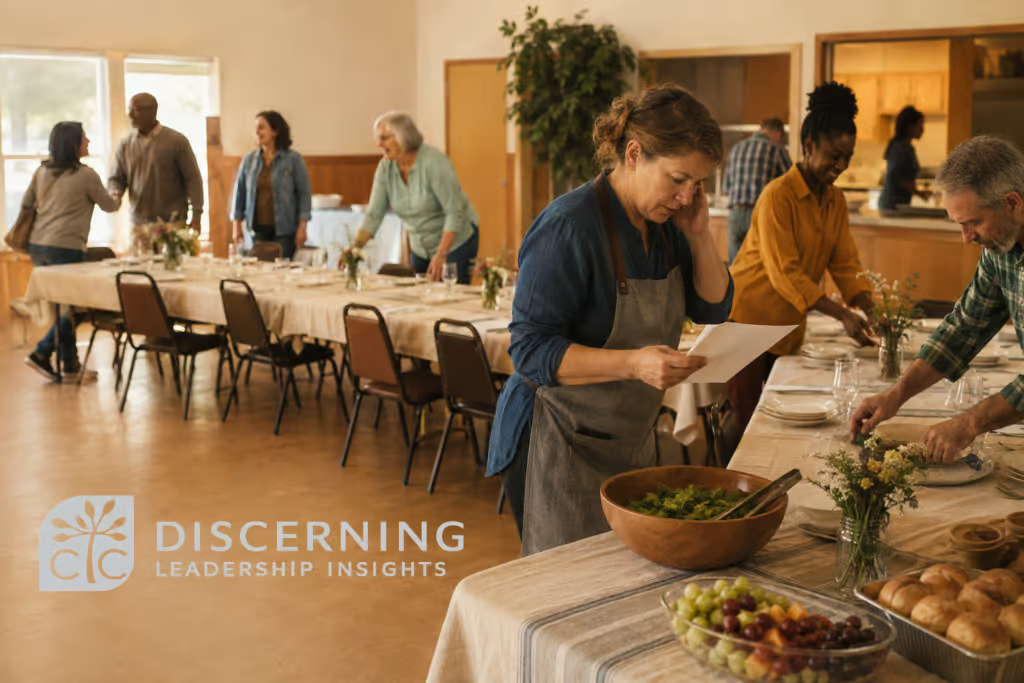
The congregation’s community meal had become one of its most visible ministries. Attendance had increased steadily. Neighbors who rarely entered the sanctuary came through the fellowship hall each week, volunteers formed new relationships, and local organizations began referring people to the church.
Leaders understandably saw the ministry as evidence of Growth and Witness. They began discussing an additional meal each month and considered renovating the kitchen to accommodate more people.
Yet another pattern was developing. Two volunteers carried most of the planning. Food costs were rising faster than designated contributions. The ministry had no clear process for purchasing, scheduling, or responding when key leaders were unavailable. Some participants wanted deeper relationships with the congregation, but no one had clarified who would nurture those connections.
The ministry was alive. It was also becoming fragile.
Reading only the visible success could lead the church to expand too quickly. Reading only the strain could lead leaders to reduce a meaningful ministry before understanding what it had made possible. The congregation needed to consider several rhythms together: the Growth taking place among participants, the Witness expressed through hospitality, the Sustainability of the work, the Clarity of responsibility, and the Discernment required before expanding it.
Congregational life rarely explains itself through one sign.
A Congregation Has More Than One Rhythm
Guiding The Vision identifies five rhythms that help leaders interpret the life of a congregation: Growth, Witness, Sustainability, Clarity, and Discernment. These rhythms are not departments or performance categories. They describe movements within the church’s shared life and the ways those movements affect one another.
Growth includes the emergence and maturation of life. Numerical increase may be part of it, but Growth can also appear through deeper formation, healthier participation, new relationships, developing leadership, greater honesty, or the willingness to release practices that no longer fit the congregation’s current understanding of Calling.
Witness is the outward expression of the church’s life. It becomes visible through service, hospitality, justice, proclamation, generosity, community presence, and the ways people encounter the congregation beyond its internal meetings and programs.
Sustainability concerns whether the church has the Energy, Resources, Capacity, systems, and boundaries needed to carry its work faithfully over time. A ministry may be meaningful and still become unsustainable when it depends upon exhausted people, unclear funding, neglected administration, or assumptions that no longer reflect reality.
Clarity gives enough shared understanding for people to act responsibly. It concerns priorities, roles, decisions, authority, boundaries, and expectations. Clarity helps prevent important work from depending upon private knowledge or the persistence of a few reliable people.
Discernment is the continuing practice of listening, interpreting, responding, observing, and correcting. It helps a congregation examine what it understands Calling to require in a particular season while remaining open to new information and the possibility that its first interpretation may be incomplete.
None of these rhythms can establish congregational faithfulness by itself. Increased participation does not automatically prove Growth. Financial stability does not necessarily demonstrate Sustainability. A clearly organized ministry may serve the church’s Calling, or it may preserve activity that has lost its purpose. The rhythms become most useful when leaders consider how they move together.
How Life Generates Life
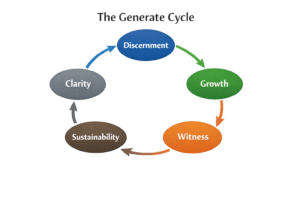
The Generate Cycle describes how one rhythm can nourish another.
Discernment may reveal a need, gift, relationship, or possibility that the congregation had not previously recognized. Responding to that perception can generate Growth as people learn, participate, or develop new Capacity. Growth can become Witness when the congregation’s changing life takes visible form in the community. Witness then creates questions of Sustainability because outward work requires people, money, structures, and continuity. Sustainability invites Clarity about roles, limits, priorities, and responsibility. Greater Clarity can make more room for Discernment because leaders spend less time resolving preventable confusion and more time attending to what the congregation is experiencing.
This movement is not automatic. It describes a relationship leaders may observe rather than a formula they can control.
The community meal illustrates that generative movement. Discernment may have led the church to recognize food insecurity and social isolation in its neighborhood. The meal created Growth through new relationships and volunteer participation. That Growth became Witness as neighbors experienced the church’s hospitality. The ministry’s increasing reach then exposed Sustainability questions involving money, leadership, facilities, and volunteer Capacity. Addressing those questions required Clarity, which could prepare the congregation for deeper Discernment about whether expansion, partnership, or a different form of ministry should come next.
A church may enter this movement at any point. A clearer committee structure might create space for better listening. A sustainable financial practice might allow a congregation to respond to an emerging need. A new form of Witness may reveal Growth already occurring beneath familiar institutional patterns.
The cycle helps leaders notice how life in one area may support life elsewhere.
The Right Measure of a Good Thing
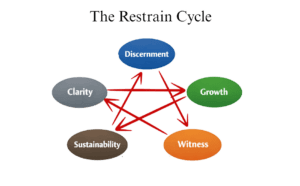 The Restrain Cycle describes healthy regulation among the rhythms. Each rhythm can bring right measure to another so that a genuine strength does not become distorted through excess.
Clarity restrains Growth by requiring leaders to identify who will carry new work, what Resources it requires, and what must be released to make room for it. Growth restrains Sustainability by reminding the church that stability exists to support life rather than protect the institution from every risk. Sustainability restrains Discernment by requiring reflection to move toward responsible choices that can actually be carried. Discernment restrains Witness by testing whether outward activity arises from Calling or from anxiety, guilt, competition, or the desire to appear successful. Witness restrains Clarity by keeping policies, roles, and structures connected to the people and purposes they are intended to serve.
Restraint here is a form of care. It does not weaken a healthy rhythm. It protects the relationships that allow the whole body to remain responsive.
Suppose the congregation considering a second community meal feels pressure to act quickly because demand is visible. Clarity may require leaders to name purchasing procedures, volunteer roles, safety responsibilities, and decision-making authority before expansion. Sustainability may require a realistic budget and a plan that does not depend upon the same two people. Discernment may lead the church to ask whether another meal is the most faithful response or whether collaboration with a neighboring organization would serve people more responsibly.
At the same time, Growth may challenge a cautious council that wants every uncertainty resolved before approving any change. Witness may remind leaders that administrative order exists to support actual relationships, not to protect the church from every inconvenience.
The rhythms correct one another without becoming enemies.
Reading Patterns Instead of Isolated Events
Church leaders often encounter congregational life through immediate problems. Attendance falls. A committee struggles. Giving changes. A ministry grows rapidly. Conflict appears around a decision. Each event deserves attention, but one event rarely explains the condition of the whole congregation.
A rhythm becomes visible through recurrence. Leaders can ask where Energy consistently gathers, which responsibilities repeatedly remain unfinished, where people experience life, and where they experience depletion. They can examine whether the same confusion appears across several ministries or only within one role. They can notice whether outward activity is deepening relationships or merely increasing demands.
This kind of reading should remain modest. Leaders may identify a possible pattern, make a limited adjustment, and observe what follows. The community meal might add one coordinator, clarify purchasing authority, and postpone expansion for three months while leaders study volunteer Capacity and participant needs. The result would provide new information. It would not certify that the church had discerned perfectly.
Good process shapes human attention. It does not activate the Spirit, guarantee moral adequacy, or prove divine approval. The Spirit is already active before leaders study the rhythms, and a congregation’s understanding of Calling remains partial and open to correction.
The framework also cannot replace responsibilities that are already clear. Legal, fiduciary, financial, employment, safety, accessibility, and pastoral obligations still require appropriate action. Misconduct or harm may demand immediate protection, investigation, accountability, or repair. Leaders should not use the language of patient observation to postpone what responsibility already requires.
Attending to the Whole Body
The five rhythms give church leaders a way to look beyond the loudest symptom without pretending that congregational life can be reduced to a diagnostic system. They help leaders consider whether an apparent strength is supported by the rest of the body, whether a recurring strain is being misread, and whether one good impulse has moved beyond its right measure.
The community meal may eventually expand. It may remain monthly and deepen its relational work. The congregation may develop new leaders, seek a partner, revise its budget, or recognize that another need has become more important. None of those outcomes alone would prove faithfulness.
What matters first is that the church learns to see the ministry in relation to the whole of its life. Its Growth, Witness, Sustainability, Clarity, and Discernment are already interacting, whether leaders name them or not.
A council may return to the conversation after several months with different information than it had before. Volunteers may speak more honestly about Capacity. Participants may describe needs the church had not recognized. Financial limits may become clearer. A partnership may emerge that changes the available choices.
The next decision will still require judgment, responsibility, and the willingness to be corrected. The congregation will have listened more carefully to the life taking shape among its people, its neighbors, and the structures through which its ministry is carried.